
Getting a ride today feels like magic. You pull out your phone, tap the screen a few times, and a car arrives at your exact location in minutes. Over the last ten years, ride-hailing apps have completely changed how we travel in cities. They replaced the old, frustrating habit of standing in the rain to wave down a passing yellow cab. Instead, we now have a smooth, predictable, and easy-to-track digital system. Millions of people rely on these services every single day to get to work or go home safely. Millions of drivers also use them to earn a living on their own schedule. But behind the sleek design and moving GPS cars, a big question remains. How do these massive digital platforms actually make a profit?
It is easy to assume these companies just take a small cut of the fare and call it a day. While that is partly true, the reality of the modern taxi business is much more complex. If you are an entrepreneur looking to enter this busy market, you have to plan carefully. Your very first step might involve hiring a Taxi app development company to build your digital system. But once the code is finished and the app is live on the app store, how do you make your money back? The answer is a highly mixed, multi-level money-making strategy. It goes far beyond simply moving a person from point A to point B. To truly understand the economics of the ride-hailing industry, we need to look under the hood. We must examine the various engines driving their overall revenue.
The Foundation: The Aggregator Business Model
Before diving into specific revenue streams, we must understand the basic business model that almost all major taxi apps use. They do not operate like traditional taxi fleets. A traditional taxi company owns the cars, pays for the commercial insurance, and hires drivers as direct employees. This method costs a massive amount of money to start and run.
Modern taxi apps are built on an aggregator model (also known as a peer-to-peer network). In this setup, the tech company does not own the vehicles.
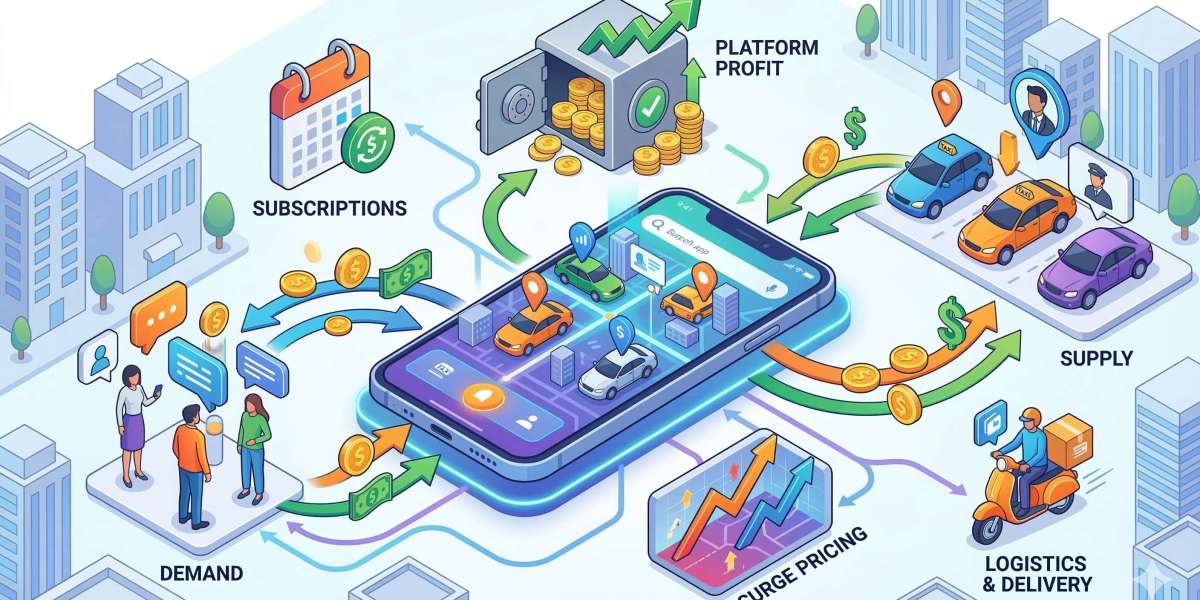
Instead, they act as a digital matchmaker. They provide the software platform that connects a person who needs a ride (the demand) with a person who has a car and is willing to drive (the supply). By removing the heavy cost of owning physical cars, these companies can grow globally at an incredibly fast pace. Their primary product is not the transportation itself; their product is the technology that makes the transportation happen.
Core Revenue Stream 1: The Commission Fee
The most obvious way taxi apps make money is by taking a commission on every single ride. Whenever a passenger pays for a trip, the total amount is split between the driver and the app platform.
Typically, the app will take a percentage ranging from 15% to 30% of the total fare. This commission is not pure profit, though. It covers the heavy costs of running the platform, which include:
Paying for app maintenance and massive cloud servers.
Funding 24/7 customer support and safety teams.
Covering credit card payment processing fees.
Running background checks for all new drivers.
Paying for local marketing and discount promotions to win new users.
While taking 20% might sound small on a standard ten-dollar ride, it adds up fast. When you multiply that small cut by millions of rides happening around the globe every single day, the revenue generated is staggering. This volume-based approach is the absolute lifeblood of the ride-hailing business.
Core Revenue Stream 2: Dynamic "Surge" Pricing
If you have ever tried to book a ride right after a large concert ends, or during a sudden rainstorm, you have experienced surge pricing. While passengers generally dislike it, surge pricing is a brilliant economic tool. It is also a massive revenue driver for the apps.
Surge pricing is an automated computer algorithm based on real-time supply and demand. When there are more riders looking for cars than there are available drivers in a specific area, the app automatically increases the price of the ride.
This accomplishes two vital things for the business:
It balances the network: The higher prices encourage more drivers to log onto the app. They drive toward the busy area to earn more money, which eventually meets the high passenger demand.
It boosts profit margins: The platform still takes its standard percentage cut. But, because the total fare is temporarily doubled or tripled, the company’s actual cash profit for that specific ride increases significantly.
Beyond the Basics: Finding New Ways to Earn
Relying only on standard ride commissions is risky. To build truly stable businesses, modern taxi apps have developed highly creative secondary revenue streams.
Premium Vehicle Categories
Not everyone wants to ride in a standard, everyday car. Taxi apps divide their customers into different groups by offering different levels of service. You can choose a standard cheap ride, a larger SUV for groups, a luxury black car for important business meetings, or even a quiet electric vehicle.
By offering these premium choices, the app can charge a much higher base fare. Business executives and luxury travelers are often willing to pay extra for comfort and style. The platform takes its percentage of these higher fares, which boosts overall revenue without needing to find new customers.
Cancellation Fees and Wait Times
Time is money, especially in the gig economy. If a driver arrives at a pickup spot and has to wait more than a few minutes for the passenger, the app starts charging a per-minute wait fee. Similarly, if a passenger requests a ride and then cancels it after the driver has already started driving toward them, a strict cancellation fee is charged.
While a portion of this money goes to the driver to pay them for their wasted time and gas, the platform also keeps a cut. These small fees seem minor, but they add up quickly across millions of users. They effectively allow the app to make money off of time itself.
In-App Advertising and B2B Partnerships
As taxi apps grow into massive platforms with millions of users checking their screens daily, they become very valuable real estate for advertisers. Many apps now feature built-in advertising.
Promoted destinations: Local restaurants or retail stores can pay to be featured on the app's map. They might offer discounts if a rider sets their store as the drop-off point.
On-screen entertainment: Some platforms partner with media companies to show video ads on tablets placed in the backseats of the cars.
Corporate accounts: Taxi apps offer business-to-business (B2B) dashboards for large companies. This software helps businesses manage their employees' travel expenses. The app might charge a monthly management fee for this specialized corporate service.
The Power of the Monthly Subscription
One of the biggest challenges for ride-hailing companies is keeping users loyal. Because it costs nothing to download a new app, a passenger will happily open a rival app if it means getting a ride two minutes faster or for a dollar less. To fight this problem, the industry has heavily shifted toward monthly subscription models.
Programs like Uber One or Lyft Pink charge users a flat monthly or yearly fee. In exchange, subscribers get exciting perks. These perks include discounted rides, free food delivery, faster customer support, and no cancellation fees.
From a business perspective, subscriptions are the holy grail. They provide Monthly Recurring Revenue (MRR). This means the company has a predictable, guaranteed income stream every single month, whether people ride frequently or not. Furthermore, psychology plays a huge role here. Once a user pays for a subscription, they feel committed. They are highly unlikely to check a competitor's app, locking them entirely into one company's digital ecosystem.
Expanding the Empire: Logistics and Delivery
It is impossible to talk about taxi app revenue without mentioning the shift into general logistics. Once an app has built a massive network of active drivers and a powerful map-routing system, that network can transport anything. It does not just have to be people.
This is exactly why major platforms expanded heavily into food delivery, grocery delivery, and package courier services. By using the exact same underlying technology and the same pool of drivers, they opened up entirely new multi-billion-dollar industries. They take commissions from local restaurants, charge delivery fees to hungry consumers, and multiply their revenue potential using the assets they already built.
Mini Case Scenario: The Hyper-Local Disruptor
Let’s look at a practical example of how a new, smaller app might twist this business model to survive against the giants. Imagine a startup called "CityRide" launching in a mid-sized urban city. They know they cannot compete with global giants who have billions of dollars in funding.
Instead of taking a 25% commission on every ride, CityRide tries a different approach. They implement a zero-commission subscription model for their drivers. Drivers pay a flat fee of $150 a month to access the CityRide software, and in return, the drivers get to keep 100% of their ride fares.
For a full-time driver, this is a fantastic deal. They make much more money keeping their full fares. For the CityRide company, they sacrifice the per-ride profit, but they gain massive loyalty from the drivers. They also get a predictable, safe monthly income based on driver subscriptions. This unique approach allows them to rapidly steal the best drivers in the city away from the giant apps. This shows just how flexible the software business model can be when you think outside the box.
Conclusion: The Road Ahead for Ride-Hailing
The ride-hailing industry is no longer just about driving people around. It has grown into a highly complex digital world powered by smart pricing, monthly subscriptions, and clever business partnerships. As technology keeps moving forward, we will likely see even more creative ways for these platforms to make money. If you are inspired to build the next big thing in city travel, understanding these money-making methods is your first crucial step. Ultimately, success comes down to mixing a great user experience with a solid financial plan. To turn these ambitious concepts into reality, partnering with a reliable Mobile App Development Company can provide the technical skills you need. They can help you build a fast, secure platform that handles rapid growth without crashing. The market is highly competitive, but there is always room for an app that solves a real problem quickly and fairly. So, how will your new platform change the way the world moves?
Frequently Asked Questions
1. Do taxi apps own the cars that pick me up?
Ans: No, the vast majority of modern ride-hailing apps use an aggregator model. They do not own the vehicles. Instead, they provide the software platform that connects independent car owners with passengers looking for a ride.
2. Why does the price of a ride suddenly double during busy times?
Ans: This is known as surge pricing. When passenger demand is much higher than the supply of available drivers, the app's computer system automatically raises prices. This encourages more drivers to come to the busy area to earn extra money.
3. Are monthly subscription plans actually profitable for the company?
Ans: Yes, they are highly profitable. While the company might make a little less money on individual discounted rides, subscriptions provide guaranteed monthly revenue. More importantly, they create deep customer loyalty that stops users from switching to rival apps.
4. How much of the total fare does the driver actually keep?
Ans: It varies by company and city, but generally, drivers keep between 70% and 85% of the base fare. The app platform keeps the remaining 15% to 30% to pay for using their software, customer support, and payment processing.
5. Do taxi apps make money from anything other than passenger rides?
Ans: Absolutely. Many major apps have found new ways to earn. They generate huge amounts of revenue through food and grocery delivery services, showing in-app advertisements, charging cancellation fees, and offering corporate travel software to large businesses.