
Corporate compliance plays a critical role in maintaining transparency, accountability, and legal integrity in the business ecosystem. In India, regulatory authorities periodically introduce compliance frameworks and schemes to encourage companies to regularize their statutory filings and rectify past defaults. One such regulatory initiative is the Companies Compliance Facilitation Scheme 2026, designed to provide companies with an opportunity to address pending compliance requirements and align with statutory obligations under corporate law.
The Companies Compliance Facilitation Scheme 2026 reflects the broader regulatory objective of improving corporate governance standards while allowing defaulting companies to correct past non-compliance within a structured framework. This article provides an informational overview of the scheme, its objectives, key features, eligibility, procedural aspects, and its broader implications for companies operating in India.
Background of Compliance Facilitation Schemes in India
Over the years, the Government of India has introduced several compliance schemes to help companies regularize statutory filings. These initiatives are generally implemented by the Ministry of Corporate Affairs (MCA), which administers corporate law compliance under the Companies Act.
Such schemes typically aim to:
Encourage companies to file overdue documents
Reduce the number of inactive or non-compliant entities in the registry
Improve accuracy in corporate records maintained by the regulator
Promote transparency and accountability in corporate governance
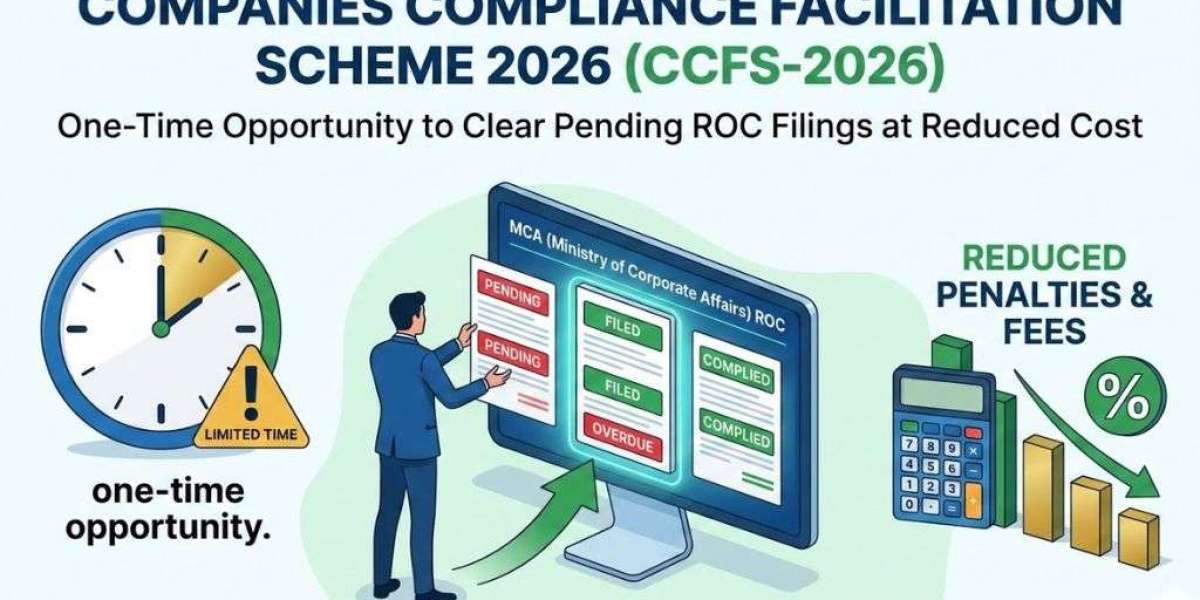
The Companies Compliance Facilitation Scheme 2026 is expected to follow similar objectives by providing a temporary window for companies to correct compliance lapses without facing the full extent of penalties normally applicable under the Companies Act.
Purpose of the Companies Compliance Facilitation Scheme 2026
The Companies Compliance Facilitation Scheme 2026 is primarily intended to assist companies that have fallen behind in meeting statutory filing obligations. Corporate filings such as annual returns, financial statements, and other regulatory documents are mandatory under company law, and delays in filing can attract penalties and legal consequences.
The scheme therefore seeks to:
Provide a structured mechanism for companies to complete pending filings.
Improve the accuracy and completeness of corporate data available with regulators.
Encourage voluntary compliance among companies.
Reduce the administrative burden associated with long-standing non-compliance cases.
Facilitate the orderly functioning of the corporate regulatory system.
By introducing the Companies Compliance Facilitation Scheme 2026, regulators aim to balance enforcement with an opportunity for corrective compliance.
Key Features of the Companies Compliance Facilitation Scheme 2026
Although the detailed operational guidelines of the Companies Compliance Facilitation Scheme 2026 may vary depending on the official notification issued by the regulatory authority, compliance facilitation schemes typically include several common features.
1. Limited Time Window
The scheme generally operates for a specific period during which companies can submit overdue filings. Companies that utilize the scheme within the prescribed timeframe can regularize their compliance status.
2. Filing of Pending Documents
Under the Companies Compliance Facilitation Scheme 2026, companies may be allowed to file various pending documents, including:
Annual returns
Financial statements
Compliance forms required under the Companies Act
Other statutory filings that were previously delayed
These filings are typically submitted through the MCA portal or other designated electronic filing systems.
3. Relaxation in Additional Fees or Penalties
In many compliance schemes, additional fees or penalties for delayed filings may be reduced or capped. This provision encourages companies to complete pending filings that might otherwise remain unresolved due to accumulated penalties.
However, the exact extent of such relief depends on the official guidelines issued under the Companies Compliance Facilitation Scheme 2026.
4. Opportunity for Inactive Companies
Compliance facilitation schemes often provide an opportunity for inactive or dormant companies to regularize their records. In some cases, companies may also choose to initiate voluntary strike-off procedures after completing necessary compliance filings.
5. Digital Filing Process
Most filings under the Companies Compliance Facilitation Scheme 2026 are expected to be completed through electronic platforms, ensuring transparency, documentation, and efficient record management.
Eligibility Under the Companies Compliance Facilitation Scheme 2026
The Companies Compliance Facilitation Scheme 2026 is generally intended for companies that have failed to comply with statutory filing requirements within the prescribed time limits.
Eligible entities may include:
Private limited companies
Public limited companies
One Person Companies (OPCs)
Small companies
Certain inactive companies with pending compliance
However, regulatory schemes of this nature often exclude specific categories of companies. For example, entities involved in ongoing legal proceedings or regulatory investigations may not qualify for relief under such schemes.
Companies should carefully review the eligibility conditions mentioned in the official notification relating to the Companies Compliance Facilitation Scheme 2026 before initiating the compliance process.
Procedural Aspects of the Scheme
Companies intending to take advantage of the Companies Compliance Facilitation Scheme 2026 generally need to follow a structured process.
Step 1: Identification of Pending Filings
The first step is to review corporate records and identify all pending statutory filings that remain outstanding.
Common examples include:
Form AOC-4 for financial statements
Form MGT-7 for annual returns
Other compliance forms required under the Companies Act
Step 2: Preparation of Documentation
Once pending filings are identified, companies must prepare the necessary documentation, including:
Audited financial statements
Board resolutions
Shareholding details
Statutory registers
Accurate documentation is essential to ensure that filings submitted under the Companies Compliance Facilitation Scheme 2026 are accepted without further queries.
Step 3: Electronic Filing
The required forms and documents must be submitted electronically through the official regulatory portal.
Each form must be completed in accordance with statutory requirements and accompanied by applicable filing fees.
Step 4: Acknowledgment and Record Update
After successful submission, the system typically generates an acknowledgment confirming receipt of the filing. The corporate database maintained by regulators is then updated to reflect the compliance status of the company.
Compliance Benefits of the Scheme
The Companies Compliance Facilitation Scheme 2026 provides several compliance-related benefits to companies.
1. Regularization of Corporate Records
Companies can update their statutory filings and ensure that corporate records maintained by regulators are accurate and complete.
2. Reduction of Long-Term Non-Compliance Risks
Persistent non-compliance can expose companies and directors to legal and financial consequences. The scheme offers an opportunity to address such issues in a structured manner.
3. Improved Regulatory Transparency
When companies complete pending filings, regulatory authorities gain better visibility into corporate activities, financial data, and governance structures.
4. Facilitation of Corporate Transactions
Companies with updated compliance records may find it easier to undertake corporate actions such as restructuring, mergers, or capital raising.
Responsibilities of Directors and Management
Even though the Companies Compliance Facilitation Scheme 2026 provides an opportunity to address past defaults, directors and management remain responsible for ensuring ongoing compliance with statutory requirements.
Key responsibilities include:
Ensuring timely filing of annual returns and financial statements
Maintaining statutory registers and corporate records
Conducting board meetings and shareholder meetings as required
Adhering to disclosure and reporting requirements under company law
Compliance should be viewed as a continuous process rather than a one-time corrective measure.
Importance of Timely Corporate Compliance
Corporate compliance is a fundamental aspect of the regulatory framework governing companies in India. Regular compliance helps ensure:
Transparency in corporate operations
Accountability of management and directors
Protection of stakeholder interests
Reliable public corporate records
The Companies Compliance Facilitation Scheme 2026 should therefore be understood as a regulatory mechanism designed to encourage companies to return to a compliant status while strengthening the integrity of the corporate regulatory system.
Conclusion
The Companies Compliance Facilitation Scheme 2026 represents an important regulatory initiative aimed at helping companies address pending statutory filings and improve overall compliance with corporate law. By providing a structured framework for completing overdue filings, the scheme supports the broader objective of strengthening corporate governance and improving the quality of regulatory records.
Companies that have accumulated pending compliance requirements may use the opportunity provided by the Companies Compliance Facilitation Scheme 2026 to review their statutory obligations, update corporate filings, and ensure alignment with applicable legal provisions.
Understanding the scope, eligibility, and procedural aspects of the scheme is essential for companies seeking to regularize their compliance status and maintain adherence to regulatory requirements under the Companies Act.
Author / Reference
Mohit S. Shah & Co.
Office No. 26, 2nd Floor, Anant Building
217, Shamaldas Gandhi Marg
Princess Street, Marine Lines (East)
Mumbai – 400 002
Phone: 91-9821462283
Email: officeofmohit@gmail.com