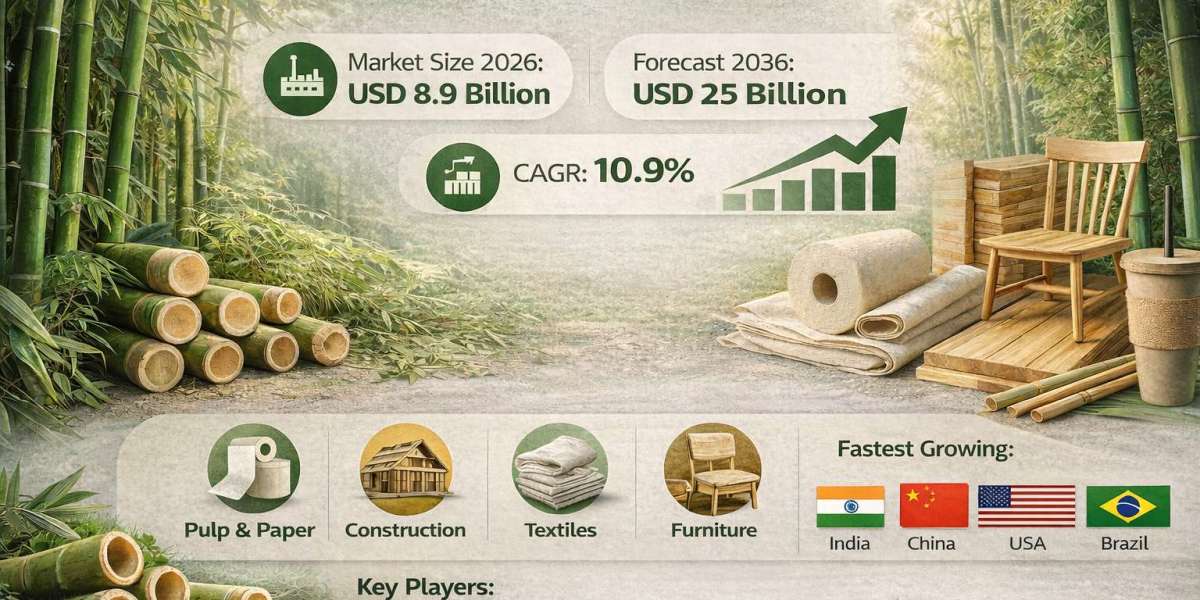

The global bamboo market is projected to expand from USD 8.9 billion in 2026 to USD 25 billion by 2036, registering a strong CAGR of 10.9%. Growth is fueled by rising demand for sustainable and renewable materials across construction, pulp & paper, textiles, packaging, and furniture industries. As environmental regulations tighten and consumer preference shifts toward biodegradable alternatives, bamboo is emerging as a mainstream industrial raw material.
Its rapid regeneration cycle, carbon sequestration potential, and versatility position bamboo as a strategic solution in global sustainability initiatives. Technological improvements in processing and engineered bamboo products are further accelerating commercial adoption worldwide.
Key Takeaways
- Market Value (2026): USD 8.9 Billion
- Forecast Value (2036): USD 25 Billion
- CAGR (2026–2036): 10.9%
- Leading Type Segment: Tropical Woody Bamboos (44.3% share)
- Top End-Use Industry: Pulp & Paper (43% share)
- High-Growth Countries: India (11.7%), China (11.4%), USA (10.2%)
Regional Analysis
Asia Pacific dominates global bamboo production and consumption, supported by favorable climatic conditions and strong government backing. India leads growth with an 11.7% CAGR, driven by policy initiatives such as bamboo cultivation programs and increased usage in green construction and furniture manufacturing. China follows closely at 11.4%, benefiting from its established processing infrastructure and export capabilities.
In North America, the United States is projected to grow at 10.2%, supported by rising demand for sustainable textiles, eco-friendly construction materials, and biodegradable packaging solutions. Brazil (8.6%) and Indonesia (8.5%) also show promising expansion, reflecting growing agricultural integration and sustainable development initiatives.
Market Dynamics and Growth Prospects
The bamboo market encompasses cultivation, processing, and commercialization across diverse applications. Demand growth is anchored in sustainability imperatives, as industries seek renewable substitutes for timber, plastics, and synthetic fibers. Bamboo’s rapid maturity, high yield per hectare, and low replanting requirements provide economic and environmental advantages.
The pulp & paper industry remains the largest consumer due to bamboo’s high cellulose content and fast regeneration cycle. Construction and engineered bamboo products are gaining momentum as architects and developers adopt eco-friendly structural materials.
Request a free Sample Report - https://www.futuremarketinsights.com/reports/sample/rep-gb-347
Innovation and Emerging Technologies
Innovation is reshaping bamboo’s industrial value chain. Engineered bamboo composites, laminated beams, and high-density panels are expanding structural applications in sustainable building projects. Advances in chemical and mechanical processing improve fiber strength and durability, enabling premium flooring, furniture, and interior applications.
Bamboo-based biochar and biodegradable composites are gaining traction in agricultural and packaging sectors. Digital traceability systems and certification frameworks are also improving transparency and export competitiveness.
Report Coverage & Deliverables
The report provides quantitative analysis in USD billion from 2026 to 2036, segmented by bamboo type and end-use industry. Type segmentation includes Tropical Woody Bamboos, Herbaceous Bamboos, and Temperate Woody Bamboos. End-use industries covered are Pulp & Paper, Construction, Food, Wood & Furniture, Textile, Agriculture, and Others.
Regional coverage spans North America, Latin America, Western & Eastern Europe, South Asia & Pacific, East Asia, and Middle East & Africa, with country-level insights for India, China, USA, Brazil, Indonesia, and additional major markets.
Leading and Emerging Players Driving Competition
The competitive landscape includes established and emerging players focused on cultivation scale, engineered processing, and sustainable product innovation. Key companies include Moso International BV, Shanghai Tenbro Bamboo Textile Co. Ltd, Kerala State Bamboo Corporation Ltd, Bamboo Australia Pty. Ltd., EcoPlanet Bamboo, Smith & Fong Co. Inc., Jiangxi Kangda Bamboo Ware Group Co. Ltd., Dasso Industrial Group Co. Ltd., and Anji Tianzhen Bamboo Flooring Co. Ltd.
Companies compete through product diversification, plantation expansion, export development, and high-performance bamboo composites tailored to construction and textile markets.
Future Outlook
Through 2036, bamboo is expected to strengthen its position as a foundational sustainable material across industries. Rising environmental awareness, supportive government initiatives, and technological advancement will continue to drive adoption. As global industries prioritize circular economy models and low-carbon materials, bamboo’s renewability and performance characteristics will underpin sustained long-term market expansion.
Request Sample Report with Complete Market Breakdowns and Growth Estimates:
https://www.futuremarketinsights.com/reports/bamboos-market
Have a specific Requirements and Need Assistant on Report Pricing or Limited Budget please contact us – sales@futuremarketinsights.com
About Future Market Insights (FMI)
Future Market Insights, Inc. (FMI) is an ESOMAR-certified, ISO 9001:2015 market research and consulting organization, trusted by Fortune 500 clients and global enterprises. With operations in the U.S., UK, India, and Dubai, FMI provides data-backed insights and strategic intelligence across 30+ industries and 1200 markets worldwide.
Why Choose FMI: https://www.futuremarketinsights.com/why-fmi