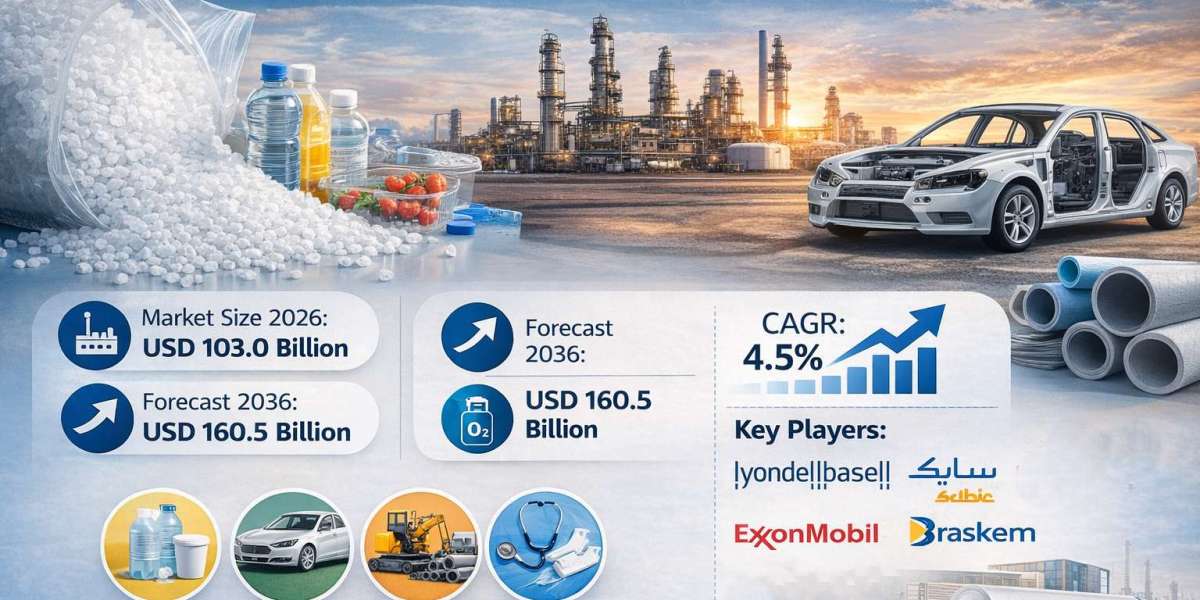

The global polypropylene market is projected to grow from USD 103.0 billion in 2026 to USD 160.5 billion by 2036, expanding at a CAGR of 4.5%. Growth is supported by rising demand across packaging, automotive, construction, healthcare, and textiles industries. Polypropylene’s versatility, durability, and cost-effectiveness position it as a preferred thermoplastic polymer in both high-volume and precision applications.
Packaging remains the largest consumption segment, while lightweight automotive components and infrastructure expansion further strengthen demand. Technological improvements in recycling and catalyst systems are reshaping the competitive landscape as sustainability priorities intensify worldwide.
Key Takeaways
- Market Value (2026): USD 103.0 Billion
- Forecast Value (2036): USD 160.5 Billion
- CAGR (2026–2036): 4.5%
- Leading Product Type: Homo-Polymer (58% share)
- Largest End-User Segment: Packaging (35% share)
- Fastest-Growing Regions: Asia Pacific, followed by North America and Europe
- Key Growth Countries: China (6.1%), USA (5.4%), Saudi Arabia (5.2%), India (4.8%)
Regional Analysis
Asia Pacific leads global polypropylene expansion, driven by China and India. China’s 6.1% CAGR reflects strong investments in petrochemical capacity, e-commerce packaging, and automotive manufacturing. Coastal industrial hubs continue to strengthen integrated value chains. India’s 4.8% CAGR is fueled by FMCG packaging growth, infrastructure development, and automotive component demand.
North America remains steady, supported by propane dehydrogenation investments and advanced recycling initiatives. The United States, growing at 5.4%, benefits from reshoring trends and innovation in electric vehicle components and medical-grade applications.
Europe, led by Germany (4.4%), focuses on engineering-grade polypropylene and circular economy integration. Meanwhile, Saudi Arabia (5.2%) expands production capacity through integrated petrochemical complexes, strengthening its export position. Brazil (4.6%) sees growth through consumer packaging and agricultural films.
Market Dynamics and Growth Prospects
Polypropylene demand is shaped by macroeconomic expansion in packaging, automotive lightweighting, healthcare disposables, and construction materials. The packaging sector dominates due to polypropylene’s moisture resistance, chemical stability, and heat-seal performance, making it essential in food, pharmaceutical, and consumer packaging.
Automotive manufacturers increasingly adopt polypropylene to reduce vehicle weight and improve fuel efficiency, especially in electric vehicles requiring durable yet lightweight battery housings and interior components. Infrastructure initiatives also boost demand for polypropylene pipes and profiles in water management systems.
Request a free Sample Report - https://www.futuremarketinsights.com/reports/sample/rep-gb-449
Innovation and Emerging Technologies
Innovation centers on sustainability and performance enhancement. Advancements in catalyst technologies enable production of specialized grades with improved mechanical strength and processability. High-melt-strength polypropylene is expanding thermoforming applications, particularly in rigid packaging.
Chemical and mechanical recycling technologies are improving recovery rates and enabling higher-quality recycled polypropylene. Integration of post-consumer recycled content into packaging and automotive components is gaining traction globally. Digital printing and customized packaging solutions create new branding opportunities, while development of polypropylene grades for electric vehicles and healthcare devices expands high-value applications.
Leading and Emerging Players Driving Competition
The polypropylene market is competitive and moderately consolidated, led by major petrochemical companies with integrated supply chains. Key players include:
- LyondellBasell Industries
- SABIC
- ExxonMobil Chemical
- Braskem
- Borealis
- TotalEnergies
- INEOS
- Reliance Industries
- Formosa Plastics Corporation
- Sinopec
Report Coverage & Deliverables
This report provides quantitative analysis in USD billion across product types, end-users, and processing methods. It covers Homo-Polymer (HP), Random Co-polymer (RCP), Impact Co-polymer (ICP), and Thermoplastic Polyolefin (TPO).
End-user segmentation includes packaging, automotive, construction, healthcare, electrical equipment, textiles, and consumer durables. Processing categories span injection molding, film & sheet (BOPP), extrusion, fiber/nonwovens, and blow molding.
Future Outlook
Through 2036, polypropylene will remain a foundational material across industrial and consumer sectors. Growth will be driven by packaging innovation, electric vehicle adoption, infrastructure modernization, and healthcare expansion. Sustainability pressures will accelerate recycling investments and development of advanced polymer technologies.
With balanced regional growth and evolving application landscapes, polypropylene is positioned for steady long-term expansion, supported by its adaptability, cost efficiency, and integration into global manufacturing ecosystems.
Request Sample Report with Complete Market Breakdowns and Growth Estimates:
https://www.futuremarketinsights.com/reports/polypropylene-market
Have a specific Requirements and Need Assistant on Report Pricing or Limited Budget please contact us – sales@futuremarketinsights.com
About Future Market Insights (FMI)
Future Market Insights, Inc. (FMI) is an ESOMAR-certified, ISO 9001:2015 market research and consulting organization, trusted by Fortune 500 clients and global enterprises. With operations in the U.S., UK, India, and Dubai, FMI provides data-backed insights and strategic intelligence across 30+ industries and 1200 markets worldwide.
Why Choose FMI: https://www.futuremarketinsights.com/why-fmi