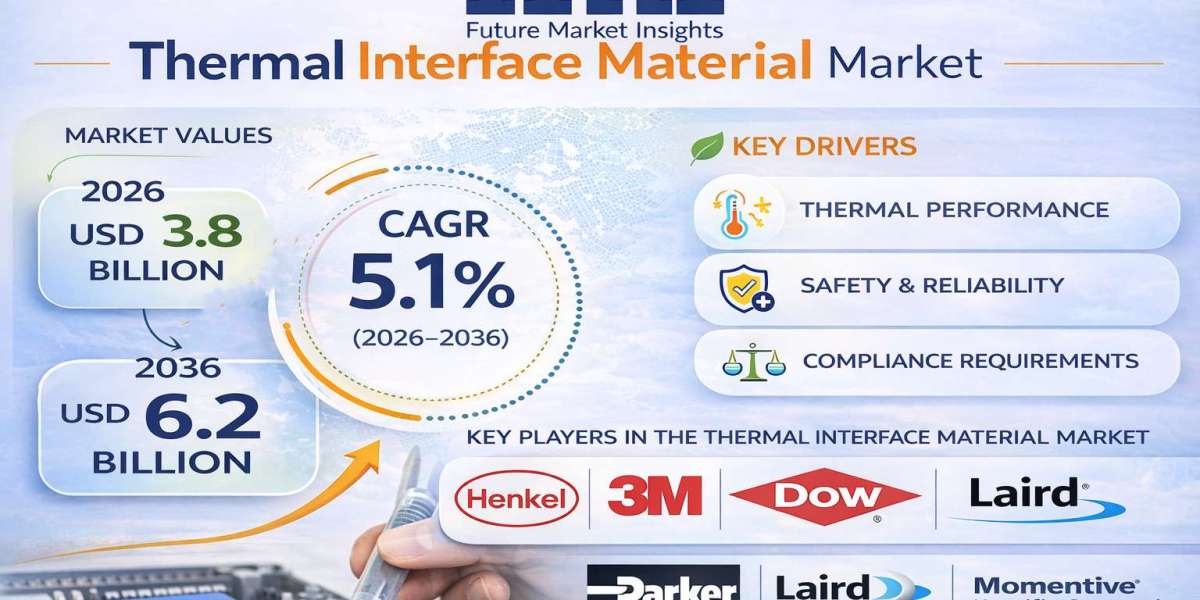

The global thermal interface material (TIM) market is entering a phase of sustained expansion, driven by rising thermal management demands across electronics, automotive, and industrial applications. Valued at USD 3.8 billion in 2026, the market is projected to reach USD 6.2 billion by 2036, growing at a CAGR of 5.1%. Increasing device miniaturization, higher power densities, and stricter safety and performance regulations are reinforcing the strategic importance of advanced thermal interface materials worldwide.
Key Takeaways
- Global TIM market expected to grow from USD 3.8 billion (2026) to USD 6.2 billion (2036).
- Moderate but steady CAGR of 5.1% reflects performance-driven demand rather than volume growth.
- Electronics and semiconductors dominate demand, accounting for over half of total consumption.
- Thermal pads and thermal pastes remain the most widely used material types.
- Growth driven by thermal performance, reliability, and compliance requirements across industries.
Regional Analysis
Asia Pacific remains the fastest-growing region, led by China, which records a 6.8% CAGR due to its dominant electronics manufacturing base and expanding automotive electronics production. South Korea follows closely, supported by strong semiconductor and consumer electronics output, while Japan continues to see stable growth aligned with automotive electronics and industrial equipment manufacturing.
In North America, the USA shows consistent expansion driven by data centers, electric vehicles, and advanced industrial systems requiring high-performance thermal management. Germany leads European demand, supported by its automotive manufacturing ecosystem and stringent quality and performance standards.
Report Coverage & Deliverables
The report delivers in-depth analysis across application types, material categories, end-use industries, and key regions. It provides quantitative forecasts in USD billion, country-level CAGR assessments, and detailed segmentation covering electronics, automotive electronics, industrial equipment, and telecommunications. Additional insights include thermal performance benchmarking, material selection criteria, supply chain dynamics, and regulatory considerations, enabling stakeholders to make informed strategic and investment decisions.
Market Dynamics and Growth Prospects
Market growth is shaped by rising heat dissipation challenges in modern electronic systems. Increasing power density, compact designs, and continuous operation cycles require materials with consistent thermal conductivity, mechanical compliance, and long-term reliability. Regulatory requirements related to product safety, fire resistance, and chemical compliance further reinforce the adoption of high-quality TIMs. While raw material availability and cost volatility pose challenges, long-term growth prospects remain positive as thermal management becomes integral to product performance and lifecycle efficiency.
Request a free Sample Report - https://www.futuremarketinsights.com/reports/sample/rep-gb-15462
Innovation and Emerging Technologies
Innovation in the TIM market focuses on enhancing thermal conductivity while maintaining ease of assembly and mechanical flexibility. Advances in phase change materials, filler technologies, and silicone-based formulations are enabling improved performance under thermal cycling conditions. Manufacturers are also investing in materials compatible with automated assembly processes and high-volume electronics manufacturing. Digital thermal simulation, material customization, and application-specific formulations are further improving efficiency and reliability across diverse use cases.
Leading and Emerging Players
Key players shaping the global TIM market include Henkel AG, 3M Company, Dow Inc., Parker Hannifin Corporation, Laird Technologies, Shin-Etsu Chemical Co., Momentive Performance Materials, and Bergquist Company. These companies focus on material performance, consistency, and technical collaboration with OEMs.
Driving Competition
Competition in the TIM market is driven by performance differentiation rather than pricing alone. Suppliers compete on thermal conductivity, mechanical stability, ease of application, and compliance with electronics and automotive standards. Long-term supply agreements, co-development with device manufacturers, and strong technical support capabilities are becoming critical competitive factors. Reliability and consistent quality remain central to customer procurement decisions.
Future Outlook
Looking ahead, the thermal interface material market is expected to maintain steady growth as electronics, electric vehicles, and industrial automation systems continue to expand. Increasing thermal loads and reliability expectations will sustain demand for advanced TIM solutions. From 2026 to 2036, the market will evolve toward higher-performance, application-specific materials, reinforcing the role of thermal interface materials as a critical enabler of next-generation electronic and industrial technologies.
Request Sample Report with Complete Market Breakdowns and Growth Estimates:
https://www.futuremarketinsights.com/reports/thermal-interface-materials-market
Have a specific Requirements and Need Assistant on Report Pricing or Limited Budget please contact us – sales@futuremarketinsights.com
About Future Market Insights (FMI)
Future Market Insights, Inc. (FMI) is an ESOMAR-certified, ISO 9001:2015 market research and consulting organization, trusted by Fortune 500 clients and global enterprises. With operations in the U.S., UK, India, and Dubai, FMI provides data-backed insights and strategic intelligence across 30+ industries and 1200 markets worldwide.
Why Choose FMI: https://www.futuremarketinsights.com/why-fmi