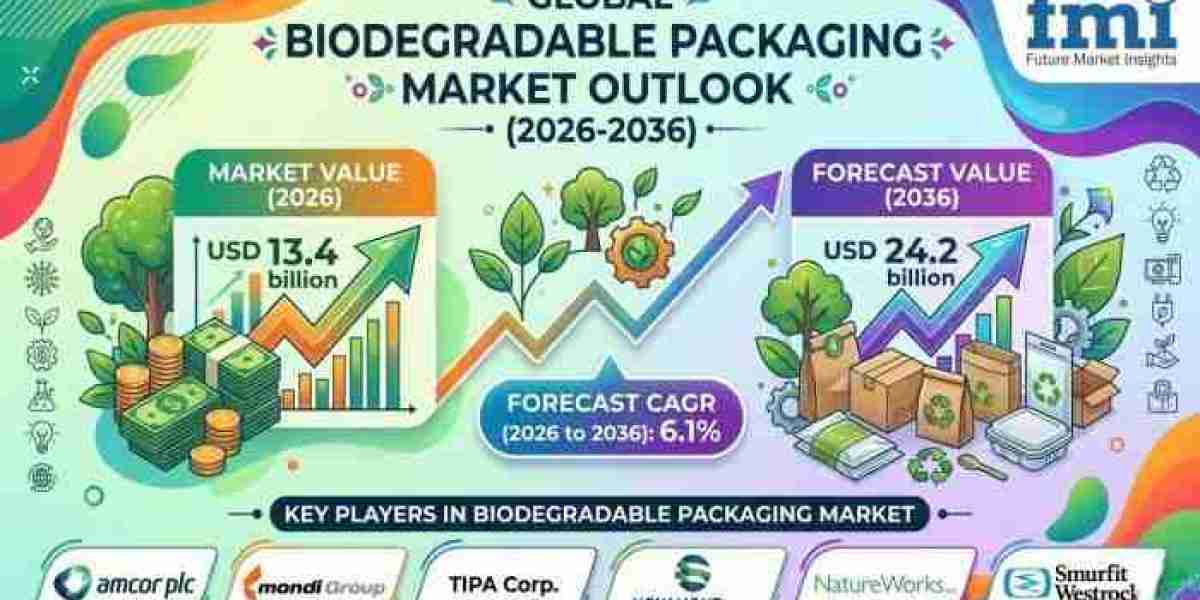

According to the latest analysis by Future Market Insights, the biodegradable packaging market is undergoing a significant transformation, evolving from a niche sustainability-focused alternative into a strategically important pillar within the global packaging industry. The market is projected to grow from USD 13.4 billion in 2026 to USD 24.2 billion by 2036, registering a CAGR of 6.1% during the forecast period.
The market’s expansion reflects a broader structural transition in packaging priorities, as manufacturers, brands, and procurement teams increasingly move away from conventional plastic dependency toward materials that align with regulatory mandates, environmental accountability, and consumer sustainability expectations.
Quick Market Highlights
- Market Value (2026): USD 13.4 Billion
- Forecast Value (2036): USD 24.2 Billion
- CAGR (2026–2036): 6.1%
- Leading End-Use Segment: Food Packaging (40.0% Share)
- Dominant Material Type: PLA-Based Packaging (41.0% Share)
- Key Growth Regions: Europe, Asia Pacific, North America
- Primary Growth Driver: Food Packaging Conversion and Regulatory Pressure
Get detailed market forecasts, pricing trends, and competitive intelligence:
https://www.futuremarketinsights.com/reports/sample/rep-gb-323
Market Evolution: From Sustainability Alternative to Strategic Packaging Solution
The biodegradable packaging market is entering a new phase of steady and strategic growth. While rising environmental awareness initially fueled adoption, the market is now increasingly driven by regulatory compliance, procurement transformation, and brand sustainability commitments.
Traditional packaging decisions historically focused on durability, cost efficiency, and logistics performance. Today, businesses are evaluating packaging materials through a broader lens that includes end-of-life disposal outcomes, regulatory readiness, recyclability, and environmental impact.
Rather than replacing conventional plastics universally, biodegradable packaging solutions are being selectively integrated into high-visibility applications where sustainability performance and regulatory scrutiny are most critical — particularly in food packaging and foodservice applications.
Key Growth Drivers Reshaping the Market
Food Packaging Conversion Accelerating Demand
Food packaging continues to dominate market demand due to its direct consumer visibility and growing waste-management concerns. Brands are increasingly transitioning toward biodegradable alternatives that support sustainability goals while maintaining food-contact compliance and operational performance.
Regulatory Restrictions on Single-Use Plastics
Governments and regulatory bodies worldwide are intensifying restrictions on conventional single-use plastics. Europe remains a leading policy-driven region, where evolving regulations are accelerating the adoption of biodegradable and compostable alternatives across packaging ecosystems.
Sustainability-Led Procurement Strategies
Procurement teams are increasingly prioritizing packaging materials that support lifecycle sustainability, compliance preparedness, and corporate ESG objectives. Certified biodegradable materials are gaining traction as businesses seek long-term packaging resilience and reputational value.
Challenges Limiting Universal Adoption
Despite strong market momentum, several operational and commercial barriers continue to influence adoption rates.
Biodegradable materials often face limitations related to moisture resistance, heat stability, and barrier protection, restricting their suitability for certain applications. Additionally, production costs remain higher than conventional plastic alternatives, impacting large-scale implementation.
Food-contact regulations and certification standards further add complexity, requiring manufacturers to meet strict compliance frameworks such as FDA and regional food safety requirements.
Moreover, the environmental effectiveness of biodegradable packaging depends heavily on real-world disposal infrastructure and composting conditions — highlighting the gap between product labeling and actual end-of-life outcomes.
Emerging Opportunities Creating New Value Pools
Several high-growth opportunity areas are expected to shape the next phase of industry expansion, including:
- Compostable foodservice packaging solutions
- Biodegradable e-commerce mailers and shipping inserts
- Molded fiber trays and clamshell alternatives
- Advanced barrier coatings for fiber-based packaging
- Lightweight biodegradable flexible packaging for logistics optimization
Segment Analysis
- By Material Type: PLA-based biodegradable packaging leads the market with a 41.0% share, supported by its widespread use across cups, trays, films, and foodservice packaging applications. Existing converter familiarity and processing compatibility continue to support adoption.
- By End Use: Food packaging remains the dominant end-use segment, accounting for 40.0% of total market share. Rising regulatory oversight and consumer awareness surrounding packaging waste continue to strengthen demand.
- By Packaging Format: Flexible biodegradable packaging formats are gaining traction due to reduced material consumption and improved transportation efficiency. Meanwhile, molded fiber and bagasse-based rigid packaging solutions remain highly attractive for applications requiring structural durability and sustainability branding.
Regional Outlook
- Europe: Europe continues to lead the global biodegradable packaging market through strong regulatory frameworks and sustainability mandates. Policies such as the Packaging and Packaging Waste Regulation (PPWR) are accelerating packaging redesign initiatives and compliance-driven innovation.
- Asia Pacific: Asia Pacific is emerging as both a major production hub and consumption center for biodegradable packaging materials. Rapid foodservice expansion, manufacturing scale advantages, and increasing PLA and molded fiber production capacity are driving regional growth.
- North America: North America remains an important innovation-driven market supported by advanced food-contact compliance standards, packaging R&D investments, and growing sustainability-focused consumer demand.
Competitive Landscape
The biodegradable packaging market remains fragmented, with competition spanning global packaging companies, material innovators, specialty converters, and regional manufacturers.
Key competitive differentiators include:
- Regulatory certification and compliance readiness
- Material formulation expertise
- Converting and processing efficiency
- Application-specific packaging performance
- Production scalability and supply chain reliability
Companies capable of balancing sustainability claims with operational functionality are expected to strengthen their long-term market positioning.
Strategic Implications for Industry Stakeholders
- For manufacturers, long-term success will depend on delivering biodegradable materials that achieve both environmental and performance benchmarks.
- For consumer brands, biodegradable packaging provides an opportunity to align sustainability commitments with evolving customer expectations — particularly in high-visibility packaging categories.
- For procurement teams, supplier selection is increasingly focused on certification reliability, consistent quality, and application-specific performance capabilities.
- For investors, attractive opportunities are emerging across material innovation, sustainable converting technologies, and advanced biodegradable packaging ecosystems.
Future Outlook
Over the next decade, biodegradable packaging is expected to witness sustained and targeted adoption growth rather than universal material replacement. Expansion will remain strongest in applications where regulatory pressure, consumer visibility, and waste-management concerns intersect.
Key trends expected to shape the market include:
- Expansion of compostable food-contact packaging
- Increased adoption of fiber-based and molded packaging solutions
- Continuous improvement in biodegradable material performance
- Stronger integration between packaging design, policy frameworks, and disposal infrastructure
As the market matures, biodegradable packaging is poised to become a critical component of broader sustainability and circular economy strategies, with growth centered on high-impact, application-specific deployment.
Executive Summary
- Biodegradable packaging is transitioning from a niche sustainability option into a strategically important packaging segment.
- Food packaging remains the leading demand generator due to regulatory scrutiny and high consumer visibility.
- Regulatory pressure particularly in Europe continues to accelerate market adoption.
- Performance limitations and cost considerations remain key barriers to widespread implementation.
- Competitive success will depend on balancing sustainability, compliance, and real-world packaging functionality.
The next phase of market evolution will be defined by targeted application adoption, regulatory integration, and performance-driven innovation rather than broad replacement of conventional packaging materials.
About Future Market Insights (FMI)
Future Market Insights, Inc. (FMI) is an ESOMAR-certified, ISO 9001:2015 market research and consulting organization, trusted by Fortune 500 clients and global enterprises. With operations in the U.S., UK, India, and Dubai, FMI provides data-backed insights and strategic intelligence across 30+ industries and 1200 markets worldwide.