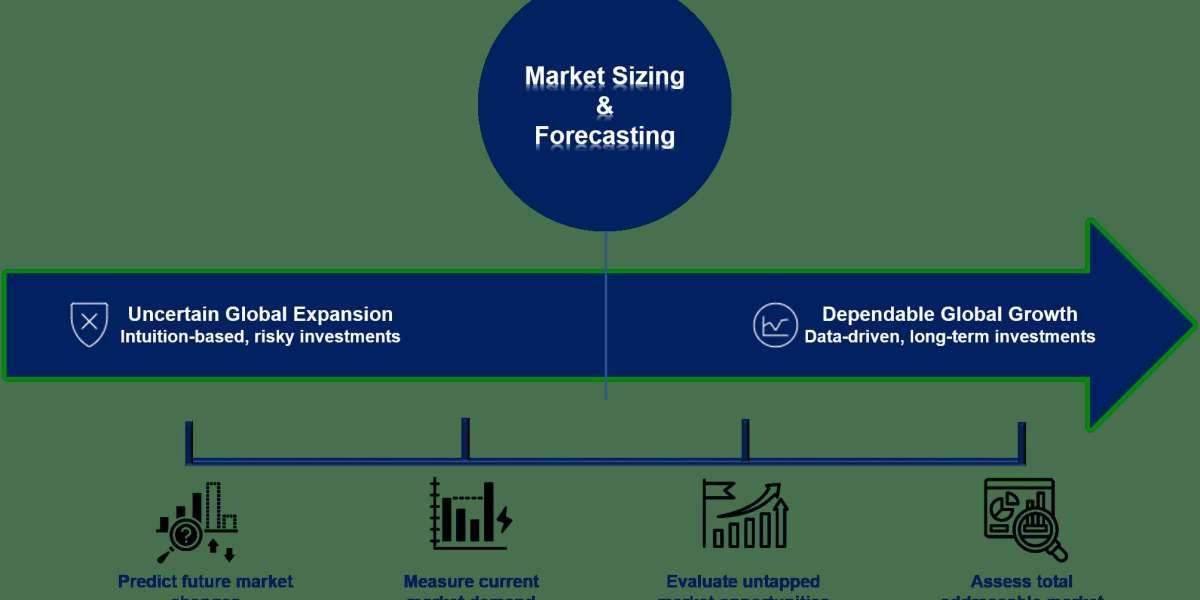

Expanding into international markets is one of the most significant growth decisions a business can make. While global expansion offers access to new customers, diversified revenue streams, and competitive advantage, it also carries substantial risk. Entering a new country without reliable data is like navigating unfamiliar terrain without a map. That’s where Market Sizing & Forecasting becomes indispensable.
Rather than relying on assumptions or isolated data points, organizations that invest in structured market evaluation gain clarity about demand, competition, and long-term potential. Through disciplined research and analytical modelling, companies can validate revenue expectations, allocate resources wisely, and create realistic expansion strategies grounded in evidence.
In today’s competitive landscape, market sizing analysis and forecasting market size are no longer optional exercises—they are strategic necessities for sustainable global growth.
The Strategic Importance of Market Sizing & Forecasting
International markets differ widely in consumer behavior, regulatory frameworks, purchasing power, infrastructure, and competitive intensity. Without understanding these variables, businesses risk overestimating demand or underestimating operational complexity.
Market Sizing & Forecasting helps organizations:
Quantify the true scale of opportunity in a target country
Identify high-growth customer segments
Evaluate competitive saturation
Forecast revenue potential over defined time horizons
Reduce uncertainty in investment decisions
Strengthen stakeholder confidence with data-backed projections
By combining quantitative modelling with qualitative insights, businesses transform uncertainty into informed strategy.
Core Components of Effective Market Evaluation
To build a reliable global expansion strategy, companies must integrate multiple analytical perspectives. Below are the essential components that form a strong framework:
1. Market Size Estimation
This process determines the current value or volume of a specific market. It answers a fundamental question: How big is the opportunity today? Accurate estimation forms the foundation of any expansion strategy.
2. Total Addressable Market (TAM)
TAM represents the full revenue potential available if a company captured 100% of its target market. While capturing the entire market is unrealistic, TAM provides a macro-level view of opportunity before narrowing down to serviceable and obtainable segments.
3. Market Demand Analysis
Understanding purchasing behavior, customer needs, and demand drivers is critical. Demand analysis evaluates what motivates buyers, how frequently purchases occur, and how price sensitivity affects sales volume.
4. Market Forecasting
Forecasting projects how the market is expected to evolve over time. It considers historical trends, economic indicators, technological shifts, policy changes, and consumer preferences to predict future performance.
5. Market Potential Analysis
Beyond current size, businesses must evaluate how the market could grow. This involves assessing unmet demand, innovation adoption, demographic changes, and long-term structural transformations.
6. Market Volume Analysis
This focuses on the quantity of goods or services consumed within a market. Volume metrics are particularly useful in industries where margins are thin and scale is essential.
7. Demand Forecasting Analysis
Using statistical models and historical data, demand forecasting predicts future buying patterns. This supports production planning, supply chain management, and investment prioritization.
8. Competitive Benchmarking
Evaluating competitors’ market share, pricing strategy, and distribution models provides context for achievable penetration rates.
Together, these components form a holistic market sizing analysis framework that supports reliable forecasting market size across geographies.