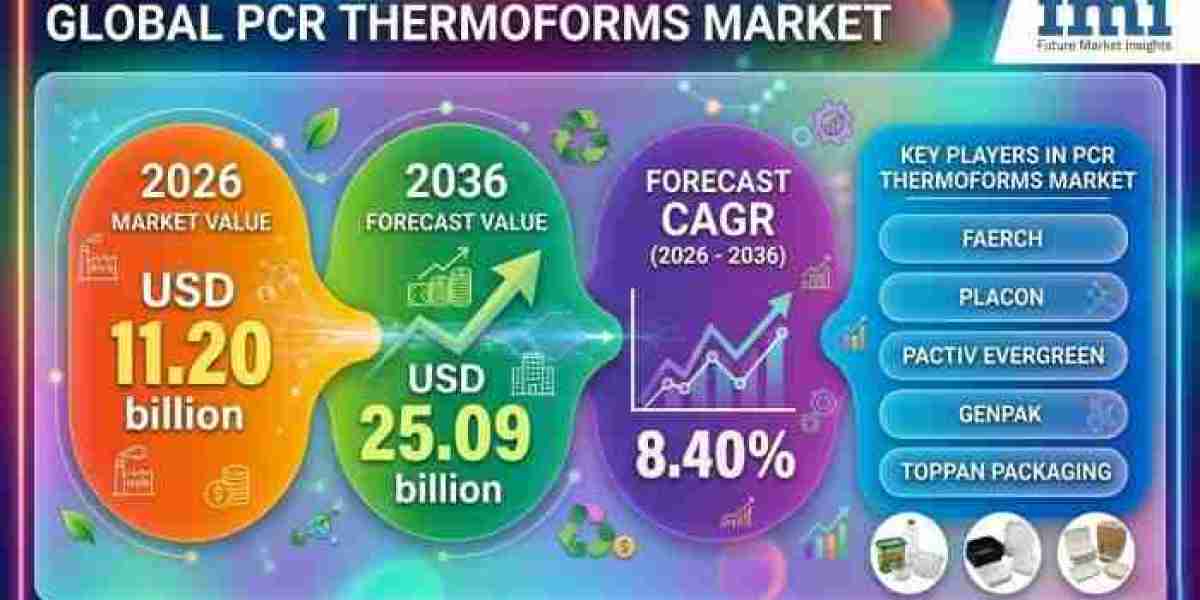

According to the latest analysis by Future Market Insights, the global PCR thermoforms market is rapidly transforming from a sustainability-focused packaging alternative into a foundational component of the circular packaging economy. The market is projected to grow from USD 10.33 billion in 2025 to USD 11.20 billion in 2026 and is expected to reach USD 25.09 billion by 2036, expanding at a CAGR of 8.40% during the forecast period.
The shift reflects a major restructuring of global packaging systems, where recycled-content mandates, plastic taxation policies, and retailer sustainability requirements are accelerating the transition away from virgin plastics toward post-consumer recycled (PCR) thermoformed packaging solutions.
Quick Market Highlights
- Market Value (2025): USD 10.33 billion
- Estimated Market Size (2026): USD 11.20 billion
- Forecast Value (2036): USD 25.09 billion
- CAGR (2026–2036): 8.40%
- Leading Material Segment: rPET (63.0% market share)
- Top Product Segment: Trays (34.0% share)
- Dominant End Use Industry: Food Packaging (56.0% share)
Get detailed market forecasts, competitive benchmarking, and pricing trends:
https://www.futuremarketinsights.com/reports/sample/rep-gb-32550
Packaging Economics Are Shifting Toward Circularity
The PCR thermoforms market is entering a strong expansion phase as packaging increasingly becomes a regulated operational requirement rather than a simple material cost consideration.
Governments worldwide are introducing extended producer responsibility (EPR) frameworks and recycled-content mandates that directly penalize excessive reliance on virgin plastics. At the same time, retailers and consumer brands are embedding sustainability metrics into procurement and supplier qualification processes.
PCR thermoforms provide manufacturers with a scalable solution for integrating verified recycled content into rigid packaging formats such as trays, clamshells, containers, and food-service packaging systems.
As compliance requirements intensify, companies delaying PCR adoption face rising exposure to regulatory costs, retailer delisting risks, and long-term supply chain instability.
Key Growth Drivers Accelerating Market Expansion
Regulatory Enforcement and Plastic Reduction Policies
Governments across North America, Europe, and Asia are implementing mandatory recycled-content requirements, transforming sustainability initiatives into enforceable compliance obligations.
Corporate Sustainability Targets
Major FMCG brands are aggressively reducing virgin plastic consumption to meet ESG commitments and public sustainability goals, increasing procurement demand for PCR-based thermoformed packaging.
Retailer-Led Packaging Standards
Large retailers are increasingly prioritizing recyclable and circular packaging systems, placing pressure on suppliers to adopt PCR packaging formats or risk losing shelf access.
Operational Challenges Continue to Impact Adoption
Despite strong market momentum, manufacturers continue to face significant production and material-related complexities.
Feedstock inconsistency remains one of the industry's largest concerns. Variability in contamination levels, intrinsic viscosity, and recycled flake quality can negatively impact extrusion stability, clarity, and production efficiency.
Higher PCR concentrations may also require slower line speeds, advanced filtration systems, or thicker material structures to maintain performance standards.
As a result, the industry's biggest challenge is no longer sourcing recycled material—but processing it consistently at industrial scale while maintaining product quality and food-contact compliance.
Emerging Opportunities Across the Circular Packaging Ecosystem
Several strategic growth areas are shaping the next phase of industry expansion:
- Development of tray-to-tray recycling systems
- AI-powered sorting and contamination detection technologies
- Growth of mono-material thermoform packaging designs
- Expansion of closed-loop packaging ecosystems
- Increased investment in food-grade PCR infrastructure
Segment Analysis
By Material
rPET continues to dominate the market with a 63.0% share due to its strong recycling infrastructure, high clarity, and compatibility with existing thermoforming operations.
By Product
Trays account for 34.0% of total market share, supported by growing demand across fresh produce, meat packaging, ready-to-eat meals, and food delivery applications.
By End Use
Food packaging remains the largest application segment with 56.0% share, driven by retailer sustainability initiatives and rising demand for recyclable rigid packaging formats.
By Process
Inline thermoforming leads with 58.0% market share due to its superior material efficiency, lower energy consumption, and integrated extrusion-forming capabilities.
By PCR Content
The 30–50% PCR content range currently dominates the market as it provides an effective balance between regulatory compliance, mechanical performance, and production efficiency.
Regional Outlook
Growth momentum varies by region depending on regulatory maturity, recycling infrastructure, and industrial adoption rates.
- India – 10.2% CAGR driven by EPR regulations and recycling formalization
- Germany – 9.1% CAGR supported by advanced circular economy policies
- China – 8.8% CAGR fueled by large-scale manufacturing integration
- United Kingdom – 8.7% CAGR driven by plastic taxation measures
- United States – 7.9% CAGR supported by state-level packaging regulations
- Brazil – 7.6% CAGR benefiting from expanding recycling infrastructure
- Japan – 7.1% CAGR driven by gradual adoption and strict quality standards
Competitive Landscape
Competition within the PCR thermoforms market is increasingly determined by access to high-quality recycled feedstock rather than production capacity alone.
Leading companies including Amcor, Pactiv Evergreen, Genpak, Sabert, TOPPAN Packaging, Placon, and Faerch are strengthening market positioning through:
- Long-term recycled feedstock agreements
- Advanced decontamination and filtration technologies
- High-clarity PCR sheet manufacturing
- Strategic recycling partnerships
- Food-contact certification capabilities
For packaging buyers, supplier selection is increasingly focused on traceability, compliance assurance, and feedstock reliability rather than pricing alone.
Strategic Implications for Industry Stakeholders
- Packaging engineers must optimize seal integrity and performance consistency across variable PCR inputs
- Procurement teams need long-term feedstock sourcing strategies to reduce supply risk
- Operations managers are investing in filtration, drying, and contamination-control systems
- Brands and retailers must balance sustainability objectives with packaging performance and shelf visibility
Future Outlook
Over the next decade, PCR thermoforms are expected to evolve from a compliance-driven packaging format into a major competitive differentiator across consumer goods and food packaging industries.
Key trends expected to shape the future market include:
- Expansion of closed-loop recycling infrastructure
- AI integration in material sorting and quality management
- Adoption of mono-material recyclable packaging systems
- Increased domestic recycling investments
- Growth of vertically integrated circular packaging ecosystems
As food-grade PCR availability improves and recycling systems mature globally, the performance and cost gap between virgin plastics and recycled thermoforms is expected to narrow significantly, positioning PCR thermoforms as a mainstream packaging standard.
Executive Summary
- PCR thermoforms are becoming core components of circular packaging systems
- Regulatory mandates and plastic taxation are accelerating global adoption
- Feedstock quality and supply security are emerging as major competitive advantages
- Operational complexity remains a key industry challenge despite strong demand growth
- Future expansion will depend on circular system integration rather than simple material replacement
The next generation of market leaders will be defined by their ability to integrate recycled materials into scalable, high-performance, and regulation-compliant packaging ecosystems.
About Future Market Insights (FMI)
Future Market Insights, Inc. (FMI) is an ESOMAR-certified, ISO 9001:2015 market research and consulting organization, trusted by Fortune 500 clients and global enterprises. With operations in the U.S., UK, India, and Dubai, FMI provides data-backed insights and strategic intelligence across 30+ industries and 1200 markets worldwide.