
Introduction: Why IT Strategy Matters
In an era where technology is central to virtually every business function, the absence of a coherent IT strategy is a serious competitive liability. Organizations without clear technology roadmaps make fragmented, reactive technology decisions — accumulating technical debt, missing strategic opportunities, and spending more than necessary on technology that doesn't deliver business value.
A well-crafted IT strategy — developed with expert technology consultant guidance — provides the compass that ensures every technology decision moves the organization toward its strategic objectives. It aligns technology investments with business priorities, sequences initiatives for maximum impact and minimum risk, and provides a framework for evaluating new technology opportunities as they emerge. This guide explores how technology consultants develop IT strategies and roadmaps that drive sustainable business success.
What Is an IT Strategy?
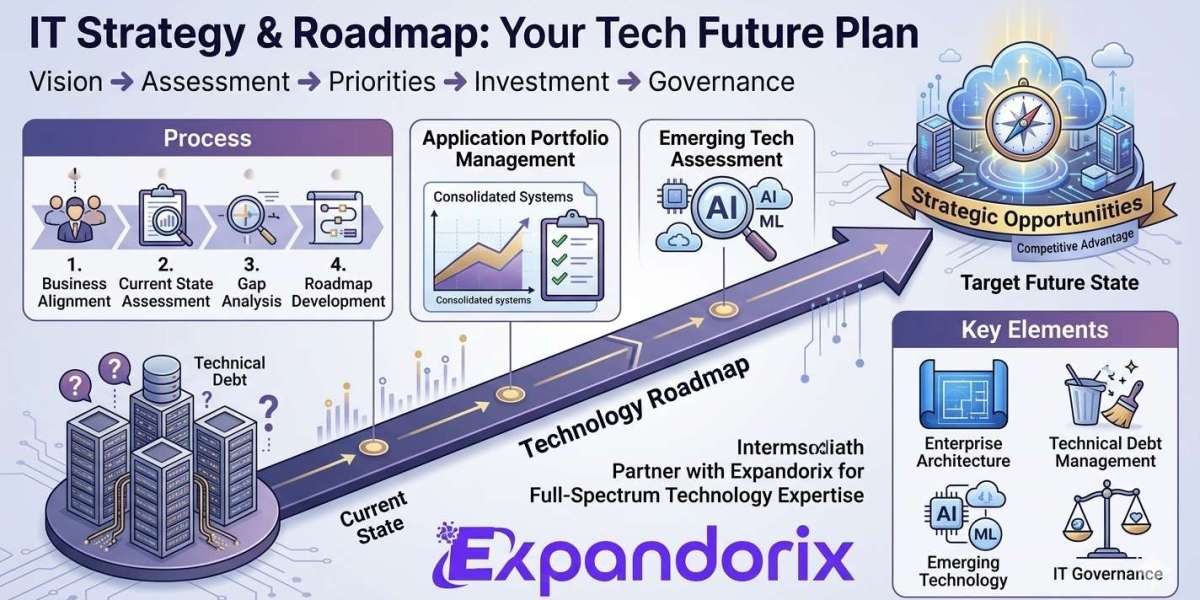
An IT strategy is a comprehensive plan that defines how technology will be used to support and advance an organization's business objectives. It encompasses several key dimensions. The Vision articulates a clear picture of the target state for the organization's technology environment — what capabilities will be in place, how technology will support business objectives, and what competitive advantages will be enabled. Current State Assessment provides a detailed, objective view of the current technology landscape — including applications, infrastructure, data, security, and organizational capabilities. Gap Analysis identifies the differences between the current state and the target vision — highlighting what capabilities need to be built, what systems need to be modernized, and what practices need to change. Strategic Priorities define the most important focus areas for technology investment over the planning horizon — typically organized around key business objectives. Roadmap defines the sequence and timing of technology initiatives — balancing strategic importance, dependencies, resource constraints, and risk. Investment Plan defines the financial investment required to execute the roadmap — including capital and operating expenditure projections. Governance Framework defines how technology decisions will be made, how investments will be prioritized, and how performance will be measured and reported. A well-crafted IT strategy provides the clarity, coherence, and alignment that transforms technology from a cost center into a genuine driver of business value.
The IT Strategy Development Process
Developing a robust IT strategy is a structured process that requires deep engagement with both business and technology stakeholders. Phase 1: Business Strategy Alignment begins with understanding the business strategy — including strategic priorities, competitive dynamics, customer expectations, and growth objectives. Technology strategy must be anchored in business strategy to deliver real value. Phase 2: Current State Assessment conducts a comprehensive assessment of the current technology environment — including application portfolio, infrastructure, data landscape, security posture, and organizational capabilities. Phase 3: Benchmarking compares the organization's current technology capabilities against industry peers and best practices — identifying performance gaps and improvement opportunities. Phase 4: Future State Vision develops a clear picture of the target technology environment — defining the capabilities that will be needed to support the business strategy over the planning horizon. Phase 5: Gap Analysis identifies the most significant gaps between the current state and the future state vision — prioritizing the most important improvement opportunities. Phase 6: Initiative Definition develops specific technology initiatives to address the identified gaps — defining scope, approach, investment, timeline, and expected outcomes for each initiative. Phase 7: Roadmap Development sequences the defined initiatives into a coherent, prioritized roadmap — considering dependencies, resource constraints, and strategic priorities. Phase 8: Investment Planning develops detailed financial projections for the technology roadmap — including capital and operating expenditure requirements. Phase 9: Governance Framework Design defines the governance structures and processes needed to execute the roadmap effectively.
Application Portfolio Management: Rationalizing Your Technology Landscape
Most organizations have accumulated a complex, often redundant portfolio of applications over time — resulting in unnecessary cost, complexity, and technical risk. Application portfolio management is a systematic approach to evaluating and rationalizing this portfolio — aligning applications with business needs, eliminating redundancy, and modernizing or retiring applications that no longer serve the organization effectively.
A technology consultant helps organizations conduct application portfolio assessments that evaluate each application across multiple dimensions: business value (does this application support critical business processes?), technical health (is this application well-maintained and built on modern, supportable technology?), total cost of ownership (what does this application cost to own and operate?), and strategic fit (does this application align with the organization's future technology direction?).
Based on this assessment, applications are categorized and disposition decisions are made — whether to invest and enhance, maintain, consolidate or replace, or retire. The resulting application portfolio rationalization typically delivers significant cost savings while improving reliability, security, and business alignment.
Technology Debt Management: A Strategic Imperative
Technical debt — the accumulated cost of shortcuts, outdated technologies, and deferred maintenance in an organization's technology environment — is one of the most significant drags on technology performance and agility. Like financial debt, technical debt compounds over time — growing more expensive and more constraining with each passing year.
Managing technical debt strategically is an important component of IT strategy. Technology consultants help organizations assess the scope and impact of their technical debt, prioritize debt remediation based on business impact, and develop realistic plans for addressing debt alongside ongoing feature development.
At Expandorix, we help organizations distinguish between different types of technical debt — intentional debt (shortcuts deliberately taken to accelerate delivery, with a plan to remediate), unintentional debt (quality issues introduced inadvertently), and environmental debt (outdated infrastructure and platforms). Each type requires a different management approach, and understanding the full picture is essential for developing an effective debt management strategy.
Enterprise Architecture: The Blueprint for Technology Alignment
Enterprise architecture is the discipline of defining and governing the overall structure of an organization's technology environment — ensuring that technology investments are aligned, integrated, and directed toward business objectives. An enterprise architect provides the "big picture" view that helps organizations make coherent technology decisions rather than fragmented, point-in-time choices.
A comprehensive enterprise architecture encompasses several domains. Business Architecture defines the business processes, functions, and organizational structures that technology must support. Application Architecture defines the portfolio of applications and how they interact to support business processes. Data Architecture defines how data is collected, stored, processed, and used across the organization. Infrastructure Architecture defines the physical and virtual infrastructure that underlies applications and data services. Security Architecture defines the security controls and frameworks that protect the technology environment.
Technology consultants help organizations develop and maintain enterprise architectures that provide the governance and coherence needed for effective technology investment and management.
Emerging Technology Assessment: Staying Ahead of the Curve
One of the most valuable functions of a technology consultant is helping organizations stay ahead of emerging technology trends — identifying which emerging technologies are relevant to their business, assessing maturity and risk, and developing strategies for adoption. The pace of technology change has never been faster — with breakthroughs in artificial intelligence, quantum computing, edge computing, and other domains creating new business opportunities and competitive threats on an almost continuous basis.
At Expandorix, our technology consultants actively monitor the emerging technology landscape — attending industry conferences, engaging with leading vendors and research institutions, and conducting technology evaluations on behalf of our clients. We provide regular technology horizon scanning reports that help our clients understand which emerging technologies merit attention and investment.
Our structured emerging technology assessment framework evaluates technologies across multiple dimensions — including business relevance, technology maturity, implementation complexity, competitive dynamics, and risk — to provide actionable guidance on technology adoption timing and approach.
IT Governance: Ensuring Technology Investments Deliver Value
IT governance defines the decision-making structures, policies, and processes that ensure technology investments are aligned with business priorities and deliver expected value. Without effective IT governance, technology investments become fragmented, priorities become unclear, and accountability for outcomes becomes diffuse.
Key components of an effective IT governance framework include Investment Prioritization processes that ensure technology investments are evaluated and prioritized based on business value, strategic alignment, and risk. Portfolio Management processes that provide visibility into the full portfolio of technology investments and enable active management of that portfolio. Architecture Review processes that ensure new technology investments are consistent with the enterprise architecture and don't create unnecessary complexity or technical debt. Project Governance processes that ensure technology projects are effectively planned, executed, and monitored — with appropriate escalation mechanisms for risks and issues. Performance Measurement frameworks that track the business outcomes of technology investments — holding both technology and business stakeholders accountable for results. Technology consultants help organizations design and implement IT governance frameworks that are rigorous but not bureaucratic — providing the oversight and accountability needed without stifling agility and innovation.
Communicating IT Strategy to Business Stakeholders
One of the most important and often underappreciated aspects of IT strategy development is communicating the strategy effectively to business stakeholders. An IT strategy that isn't understood and supported by business leaders won't deliver its intended value — regardless of its technical quality.
Effective communication of IT strategy requires translating technical concepts and plans into business language that resonates with non-technical stakeholders. This means expressing the strategy in terms of business outcomes rather than technology capabilities, using visual tools like roadmaps and capability maps to make the strategy tangible and accessible, and telling a compelling story that connects technology investments to business priorities and competitive dynamics.
At Expandorix, our technology consultants are skilled communicators who can translate complex technology strategies into compelling business narratives. We help our clients develop executive presentations, board briefings, and organizational communication plans that build the understanding and commitment needed to execute the IT strategy successfully.
Conclusion: Build Your Technology Future with Expandorix
A well-crafted IT strategy and roadmap is one of the most powerful tools a business leader can have for navigating the technology landscape. By providing clarity about where you're going, how you'll get there, and what investments are required, a strong IT strategy transforms technology from a source of complexity and cost into a driver of business value and competitive advantage.
At Expandorix, our technology consultants have helped dozens of organizations develop IT strategies and roadmaps that have transformed their technology capabilities and business performance. Our approach combines strategic rigor with practical business focus — delivering strategies that are ambitious yet achievable, comprehensive yet accessible.