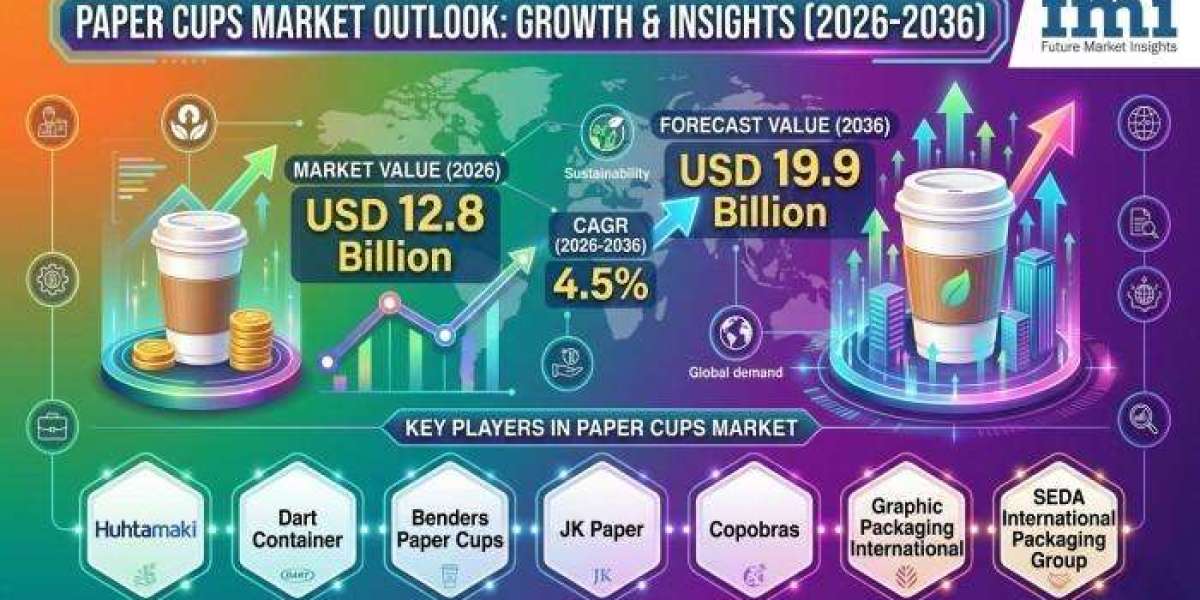

According to the latest market analysis, the paper cups market is entering a steady growth phase, driven by evolving beverage service ecosystems that prioritize speed, convenience, and operational efficiency. The market is valued at USD 12.8 billion in 2026 and is projected to reach USD 19.9 billion by 2036, expanding at a CAGR of 4.5%.
Growth remains consistent, supported by rising demand across coffee chains, quick-service restaurants (QSRs), and institutional catering. The industry is also undergoing a structural shift, where purchasing decisions are no longer based solely on cost and durability but increasingly on service compatibility, disposal clarity, and branding effectiveness.
Key Market Answer
Q: What is driving the growth of the paper cups market?
A: Growth is fueled by increasing demand for fast and convenient beverage services, high daily consumption of hot drinks, and the need for packaging solutions that combine operational efficiency with improved disposal and recycling compatibility.
Get detailed market forecasts, competitive benchmarking, and pricing trends:
https://www.futuremarketinsights.com/reports/sample/rep-gb-7591
Quick Market Statistics
- Market Size (2025): USD 12.2 Billion
- Market Size (2026): USD 12.8 Billion
- Forecast Value (2036): USD 19.9 Billion
- CAGR (2026–2036): 4.5%
- Leading End Use: Hot Beverages (52.0%)
- Leading Material: PE-coated paperboard (58.0%)
- Leading Format: Single-wall cups (48.0%)
- Fastest Growing Country: India (6.6% CAGR)
Market Overview: Shift Toward Service Efficiency
The paper cups market plays a critical role in modern beverage service, where packaging must enable fast handling, reliable performance, and easy disposal. Demand is being reshaped by three major forces:
- Expansion of takeaway and quick-service beverage culture
- Rising focus on disposal compatibility and recycling communication
- Increasing importance of branding and print quality
As a result, paper cups are evolving from a commodity product into a strategic packaging component.
Key Growth Drivers
- Expansion of Beverage Service Culture
Growing consumption of coffee, tea, and ready-to-drink beverages is driving consistent demand across cafés, workplaces, and transit locations.
- Operational Efficiency in Foodservice
Paper cups support quick filling, easy handling, and immediate disposal, making them essential in high-traffic environments.
- Branding and Customization
Foodservice providers increasingly use cups as branding tools, demanding high-quality printability and consistent design output.
Market Trends
- Hot Beverage Dominance: Driven by daily consumption habits
- Format Optimization: Single-wall cups lead due to cost and simplicity
- Material Preference: PE-coated paperboard dominates for barrier reliability
- Disposal Awareness: Increased focus on recyclability and clear instructions
- Supply Channels: Distributor-led procurement remains preferred
Segment Insights
End Use: Hot Beverages (52.0%)
Dominates due to frequent consumption and operational convenience.
Format: Single-Wall Cups (48.0%)
Preferred for:
- Easy storage and stacking
- Compatibility with standard systems
- Lower production cost
Material: PE-Coated Paperboard (58.0%)
Leads due to:
- Strong barrier performance
- Industry familiarity
- Scalability in production
Capacity: 8–12 oz (46.0%)
Favored for:
- Portion control
- Storage efficiency
- Alignment with standard menu sizes
Regional Insights
Top Growth Markets (CAGR 2026–2036)
- India: 6.6% – Driven by urbanization and takeaway culture
- China: 5.8% – Growth in organized foodservice
- Brazil: 4.8% – Demand from events and retail foodservice
- USA: 4.2% – Stable replacement demand
- UK: 4.1% – Strong takeaway culture
- Japan: 3.9% – Mature but stable market
- Germany: 3.6% – Replacement-driven growth
Regional Outlook
- East Asia: Leads with 30.0% market share
- Asia-Pacific: Fastest-growing region
- Europe & North America: Mature markets with stable demand
Competitive Landscape
The market is moderately fragmented, with competition focused on:
- Operational reliability
- Supply chain efficiency
- Product consistency
Key Players
- Huhtamaki
- Dart Container
- Benders Paper Cups
- JK Paper
- Copobras
- Graphic Packaging International
- SEDA International Packaging Group
Competitive Differentiation Factors
- Print quality and branding consistency
- Reliable supply chains
- Lid compatibility and integration
- Responsiveness to regional service needs
Recent Developments
- Launch of compostable double-wall cups with paper-based lids
- Expansion of paperboard cup innovations
- Introduction of closed-loop recyclable cup systems at large events
Expert Insight
The paper cups market is transitioning from a cost-driven commodity to a service-driven packaging solution. As beverage environments become more complex, companies that deliver consistent performance, clear disposal pathways, and reliable supply chains will gain a competitive edge.
According to the latest market analysis, the paper cups market is entering a steady growth phase, driven by evolving beverage service ecosystems that prioritize speed, convenience, and operational efficiency. The market is valued at USD 12.8 billion in 2026 and is projected to reach USD 19.9 billion by 2036, expanding at a CAGR of 4.5%.
Growth remains consistent, supported by rising demand across coffee chains, quick-service restaurants (QSRs), and institutional catering. The industry is also undergoing a structural shift, where purchasing decisions are no longer based solely on cost and durability but increasingly on service compatibility, disposal clarity, and branding effectiveness.
Key Market Answer
Q: What is driving the growth of the paper cups market?
A: Growth is fueled by increasing demand for fast and convenient beverage services, high daily consumption of hot drinks, and the need for packaging solutions that combine operational efficiency with improved disposal and recycling compatibility.
Quick Market Statistics
- Market Size (2025): USD 12.2 Billion
- Market Size (2026): USD 12.8 Billion
- Forecast Value (2036): USD 19.9 Billion
- CAGR (2026–2036): 4.5%
- Leading End Use: Hot Beverages (52.0%)
- Leading Material: PE-coated paperboard (58.0%)
- Leading Format: Single-wall cups (48.0%)
- Fastest Growing Country: India (6.6% CAGR)
Market Overview: Shift Toward Service Efficiency
The paper cups market plays a critical role in modern beverage service, where packaging must enable fast handling, reliable performance, and easy disposal. Demand is being reshaped by three major forces:
- Expansion of takeaway and quick-service beverage culture
- Rising focus on disposal compatibility and recycling communication
- Increasing importance of branding and print quality
As a result, paper cups are evolving from a commodity product into a strategic packaging component.
Key Growth Drivers
- Expansion of Beverage Service Culture
Growing consumption of coffee, tea, and ready-to-drink beverages is driving consistent demand across cafés, workplaces, and transit locations.
- Operational Efficiency in Foodservice
Paper cups support quick filling, easy handling, and immediate disposal, making them essential in high-traffic environments.
- Branding and Customization
Foodservice providers increasingly use cups as branding tools, demanding high-quality printability and consistent design output.
Market Trends
- Hot Beverage Dominance: Driven by daily consumption habits
- Format Optimization: Single-wall cups lead due to cost and simplicity
- Material Preference: PE-coated paperboard dominates for barrier reliability
- Disposal Awareness: Increased focus on recyclability and clear instructions
- Supply Channels: Distributor-led procurement remains preferred
Segment Insights
End Use: Hot Beverages (52.0%)
Dominates due to frequent consumption and operational convenience.
Format: Single-Wall Cups (48.0%)
Preferred for:
- Easy storage and stacking
- Compatibility with standard systems
- Lower production cost
Material: PE-Coated Paperboard (58.0%)
Leads due to:
- Strong barrier performance
- Industry familiarity
- Scalability in production
Capacity: 8–12 oz (46.0%)
Favored for:
- Portion control
- Storage efficiency
- Alignment with standard menu sizes
Regional Insights
Top Growth Markets (CAGR 2026–2036)
- India: 6.6% – Driven by urbanization and takeaway culture
- China: 5.8% – Growth in organized foodservice
- Brazil: 4.8% – Demand from events and retail foodservice
- USA: 4.2% – Stable replacement demand
- UK: 4.1% – Strong takeaway culture
- Japan: 3.9% – Mature but stable market
- Germany: 3.6% – Replacement-driven growth
Regional Outlook
- East Asia: Leads with 30.0% market share
- Asia-Pacific: Fastest-growing region
- Europe & North America: Mature markets with stable demand
Competitive Landscape
The market is moderately fragmented, with competition focused on:
- Operational reliability
- Supply chain efficiency
- Product consistency
Key Players
- Huhtamaki
- Dart Container
- Benders Paper Cups
- JK Paper
- Copobras
- Graphic Packaging International
- SEDA International Packaging Group
Competitive Differentiation Factors
- Print quality and branding consistency
- Reliable supply chains
- Lid compatibility and integration
- Responsiveness to regional service needs
Recent Developments
- Launch of compostable double-wall cups with paper-based lids
- Expansion of paperboard cup innovations
- Introduction of closed-loop recyclable cup systems at large events
Expert Insight
The paper cups market is transitioning from a cost-driven commodity to a service-driven packaging solution. As beverage environments become more complex, companies that deliver consistent performance, clear disposal pathways, and reliable supply chains will gain a competitive edge.