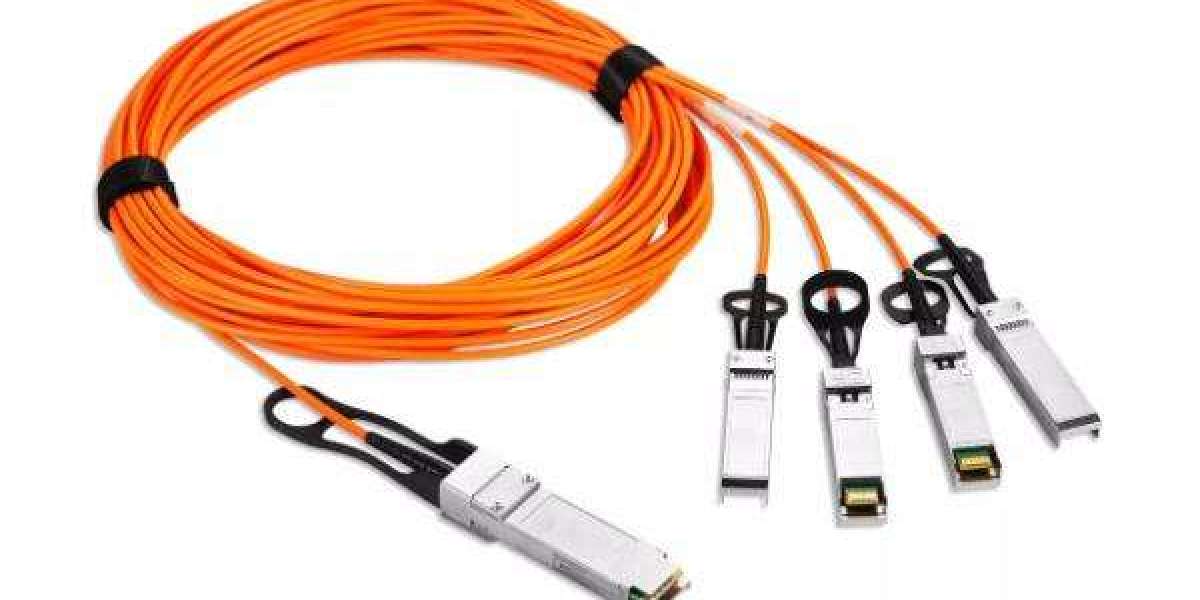

The landscape of cloud infrastructure is shifting toward a parallel optics model, where data is transmitted and received over multiple fibers simultaneously. This departure from traditional serial transmission is the primary driver behind the adoption of the mpo 24 fiber cable. In a typical 100G SR4 configuration, four fibers are used to transmit and four to receive, leaving a significant portion of a 12-fiber connector dark. By utilizing a 24-fiber backbone, network architects can maximize their return on physical duct space, supporting three separate 100G links or a single high-capacity 400G link through a single connection point.
This density is particularly beneficial in "spine-and-leaf" architectures. In these environments, the goal is to minimize the number of hops between servers to reduce latency. High-count fiber trunks allow for massive cross-connects at the spine layer, ensuring that as the "leaves" (access switches) are added, the core of the network can scale without the physical clutter of thousands of individual patch cords.
Architectural Flexibility and Modular Design
Modular design is a core principle of modern data center efficiency. By using a standardized mpo fiber cable infrastructure, facilities can implement a "build-as-you-grow" strategy. Instead of guessing how much capacity will be needed five years from now, engineers can install a high-density trunk today and simply add breakout cassettes or adapter plates as new equipment is racked.
This modularity also extends to troubleshooting and maintenance. In older, point-to-point cabling systems, identifying a single faulty strand among hundreds of loose cables was a logistical nightmare. In a structured MPO environment, links are organized into logical groups. If a trunk shows signs of degradation, the entire assembly can be tested or replaced with minimal impact on adjacent services, ensuring that uptime remains consistent with Tier III or Tier IV data center standards.
Reducing Total Cost of Ownership (TCO)
While the initial investment in multi-fiber components may be higher than traditional duplex solutions, the total cost of ownership is significantly lower over the lifecycle of the data center. The primary savings come from reduced installation labor and the elimination of complex field splicing. Furthermore, the longevity of a multi-fiber backbone means that the expensive process of "ripping and replacing" cables during speed upgrades is avoided. By future-proofing the layer one infrastructure, organizations can allocate their budgets toward active electronics and software-defined networking tools rather than physical maintenance.
Optimizing Signal Integrity in High-Speed Links
As signal speeds increase, the margin for error in the optical path shrinks. Every connection point introduces a small amount of insertion loss, and in a high-speed link, these losses can quickly add up and cause bit errors. The mpo optical cable is engineered to meet the stringent loss budgets required by modern transceivers. By utilizing premium-grade ferrules and advanced polishing techniques, these cables ensure that the connection between the fiber core and the transceiver remains stable even under the vibrations and temperature fluctuations common in large server rooms.
Return loss, the measure of light reflected back toward the source, is also a critical factor. High reflections can destabilize the laser in the transceiver, leading to intermittent connectivity issues. The precision engineering of MPO connectors ensures a physical contact (PC) or angled physical contact (APC) finish that minimizes these reflections, providing a clean path for the light to travel from the source to the destination without interference.
The Role of Gender and Pins in MPO Connectivity
One unique aspect of MPO connectors is the "gender" system, which utilizes male (pinned) and female (unpinned) connectors to ensure alignment. Typically, the trunk cables are female, while the equipment or cassettes are male. This prevents the delicate fiber faces from coming into contact with anything other than their intended mating partner. Understanding this hierarchy is essential for successful deployment, as mismatched genders will result in a total lack of connectivity.
Future Horizons: Beyond 400G
The industry is already looking toward 800G and 1.6T speeds. These future protocols will rely even more heavily on multi-fiber arrays to achieve the necessary bandwidth. The groundwork laid today with 24-fiber systems will serve as the bridge to these future technologies. By establishing a high-density, low-loss environment now, enterprises are ensuring they remain competitive in an era where data is the most valuable commodity.
As artificial intelligence and machine learning workloads become more prevalent, the demand for "East-West" traffic—data moving between servers within the data center—will continue to skyrocket. High-capacity optical trunks are the only way to manage this traffic efficiently, providing the massive "highway" required for distributed computing clusters to function at their peak potential.