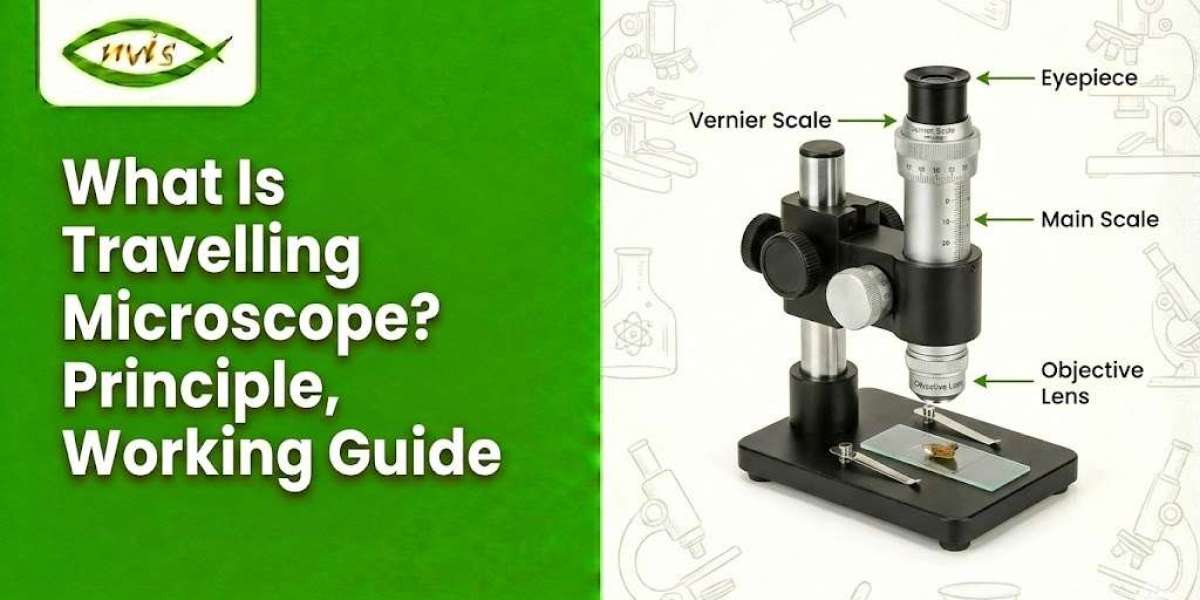

In physics and engineering laboratories, precision measurement is critical. One such highly accurate instrument used for linear and angular measurements is the travelling microscope. If you’ve ever wondered what a travelling microscope is and how professionals take accurate travelling microscope reading, this guide explains everything in simple terms.
Whether you are a student, lab technician, or researcher, understanding this instrument can significantly improve measurement accuracy in experiments.
What Is Travelling Microscope?
A travelling microscope is a precision optical instrument used to measure very small distances with high accuracy. It consists of a microscope mounted on a movable carriage that slides along a graduated scale.
The instrument moves horizontally (and sometimes vertically), allowing users to observe and measure minute displacements in experiments such as:
Refractive index determination
Surface tension experiments
Spectrometer measurements
Small object thickness measurement
Traveling Microscope is an extensively used product in Research, Colleges, Schools and Industrial laboratories for accurate measurement of the diameters of different objects. Two slow motion knobs are provided for taking accurate readings. For placing objects on a horizontal stage, a milky cenolite sheet is provided on the base. The position of the Microscope can be varied coarsely by sliding along the rails, or finely by turning the screw. The microscope is focused by rack and pinion, and has achromatic objective of 50mm focal length and eye piece with cross line graticule. The purpose of the microscope is to aim at reference marks with much higher accuracy compared to bare eyes .It is used in labs to measure refractive index of liquids using the geometrical concepts of Ray Optics. It is also used for accurate determination of small variation in the liquid levels, the refractive index of liquids as well as in surface tension & diameter of capillary tubes with precision.