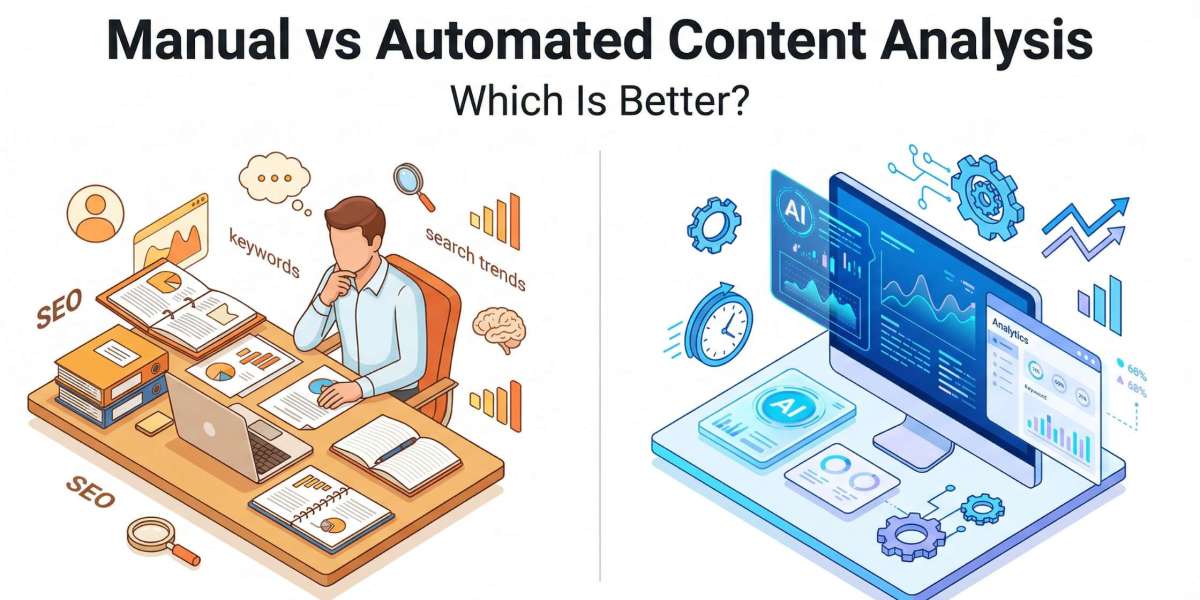

In today’s data-driven world, content analysis has become an essential method for extracting meaningful insights from text, media, and qualitative data. Whether you are a researcher, marketer, or business professional, choosing between manual and automated approaches can significantly impact your results. This blog explores Manual vs Automated Content Analysis: Which Is Better? to help you make the right decision.
What Is Content Analysis?
Content analysis is a research technique used to systematically evaluate and interpret textual, visual, or audio data. It helps identify patterns, themes, and trends that can inform decision-making. From academic research to digital marketing, content analysis plays a vital role in understanding large volumes of information.
What Is Manual Content Analysis?
Manual content analysis involves human researchers reviewing and coding data by hand. This method is often used in qualitative research where deep understanding and interpretation are required.
Advantages of Manual Content Analysis
High accuracy and depth: Humans can understand context, tone, and nuances better than machines.
Flexibility: Researchers can adapt categories and themes during the process.
Better for small datasets: Ideal when working with limited or highly detailed data.
Disadvantages of Manual Content Analysis
Time-consuming: Analyzing large datasets manually can take days or even weeks.
Subjectivity: Results may vary depending on the researcher’s perspective.
Limited scalability: Not suitable for handling massive amounts of data.
What Is Automated Content Analysis?
Automated content analysis uses software and AI-powered tools to process and analyze data quickly. It is widely used in industries dealing with big data, such as marketing and social media analytics.
Advantages of Automated Content Analysis
Speed and efficiency: Processes large datasets in minutes.
Consistency: Reduces human bias and ensures standardized results.
Scalability: Ideal for analyzing massive volumes of data.
Disadvantages of Automated Content Analysis
Limited context understanding: Machines may struggle with sarcasm, tone, or cultural nuances.
Initial setup complexity: Requires proper configuration and training.
Less flexibility: Predefined algorithms may limit adaptability.
Manual vs Automated Content Analysis: Key Differences
When comparing Manual vs Automated Content Analysis: Which Is Better?, it’s important to evaluate key factors:
Accuracy: Manual methods excel in interpreting complex data, while automated tools may miss subtle meanings.
Speed: Automated content analysis is significantly faster than manual methods.
Cost: Manual analysis may require more human resources, while automated tools involve software investment.
Scalability: Automated methods are better suited for large-scale projects.
Flexibility: Manual content analysis allows more adaptability during research.
When Should You Use Manual Content Analysis?
Manual content analysis is best when:
You are working with small datasets
Deep interpretation is required
The research involves subjective or complex themes
Accuracy and nuance are more important than speed
When Should You Use Automated Content Analysis?
Automated content analysis is ideal when:
You need to analyze large datasets quickly
You want consistent and repeatable results
The project involves structured or semi-structured data
Time and efficiency are critical factors
Which Is Better?
So, Manual vs Automated Content Analysis: Which Is Better? The answer depends on your specific needs. If your goal is deep, detailed insights, manual content analysis is the better choice. However, if you prioritize speed and scalability, automated content analysis is more effective.
In many cases, a hybrid approach works best. Combining manual expertise with automated tools allows you to leverage the strengths of both methods. This ensures both accuracy and efficiency in your content analysis process.
Conclusion
Choosing between manual and automated methods ultimately depends on your research goals, data size, and available resources. While manual content analysis offers depth and precision, automated content analysis provides speed and scalability. For optimal results, consider integrating both approaches.
At flowres, we understand the importance of effective content analysis in driving meaningful insights. By combining advanced technology with human expertise, flowres helps you achieve accurate, efficient, and scalable analysis tailored to your needs.