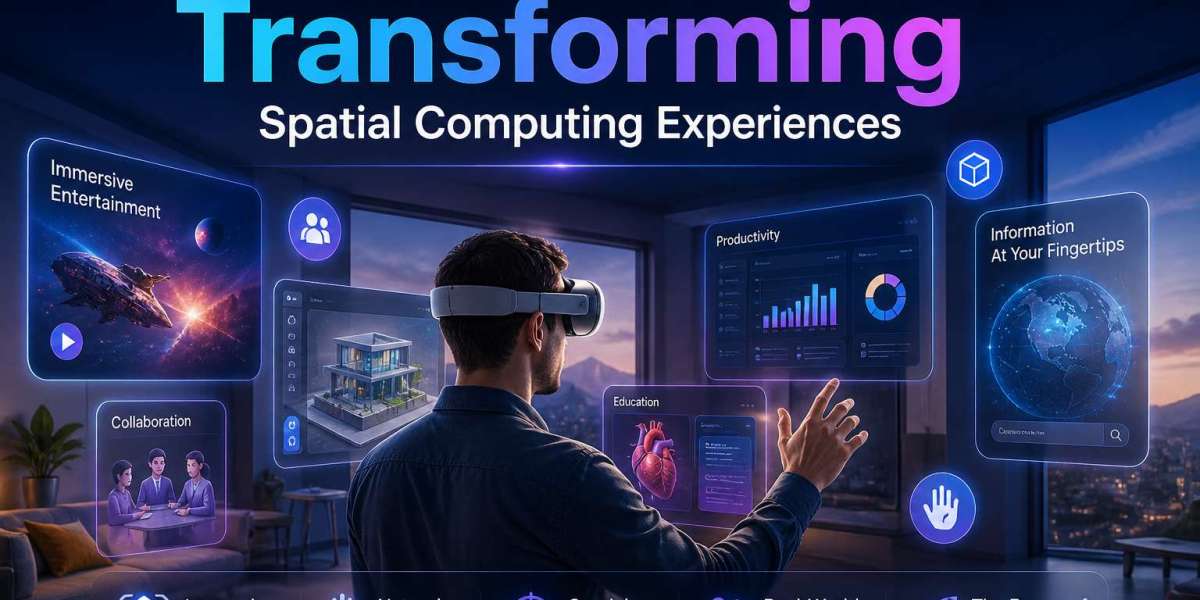

Spatial computing is shifting how people interact with digital content, and VisionOS apps sit at the center of that change. Instead of limiting users to flat screens, these applications place digital elements into real-world environments, allowing interaction through gaze, gesture, and voice. This shift changes how software behaves, how users respond, and how developers think about building experiences.
The Role of VisionOS in the New Computing Layer
VisionOS introduces a computing environment where apps are no longer confined to rectangular displays. Interfaces exist in three-dimensional space and respond to natural movement. This creates a more direct connection between user intent and digital action.
Apple Vision Pro App Development Companies play a major role in shaping this transition. They build applications that align with spatial design principles, ensuring apps respond smoothly to real-world contexts. These companies focus on blending visual design with environmental awareness so applications feel like part of the physical space rather than separate from it.
Their work often includes designing interfaces that float in space, respond to depth, and adjust based on user position. This requires a shift away from traditional UI patterns and toward spatial logic, where distance, scale, and placement become core design elements rather than afterthoughts.
How Apple Vision Pro App Development Companies Are Shaping Experiences
Apple Vision Pro App Development Companies are driving experimentation in spatial interaction design. Their work is not limited to building apps but extends to rethinking how users engage with digital environments in everyday settings.
These companies focus on performance optimization, spatial responsiveness, and intuitive interaction design. Developers must consider how apps behave when users move around a room, shift focus between objects, or interact with multiple floating elements at once.
Key areas influencing development approaches
1. Spatial User Interface Design Principles
Interfaces are designed in 3D space rather than flat screens
Elements adjust based on depth perception and user positioning
Visual hierarchy depends on spatial placement instead of screen layout
2. Interaction Through Natural Input Methods
Gaze tracking replaces traditional pointer-based navigation
Hand gestures allow direct manipulation of virtual objects
Voice commands support hands-free control in complex environments
3. Real-World Context Integration
Apps respond to surrounding physical space dynamically
Lighting and environment influence visual presentation
Digital objects can anchor to real-world surfaces for stability
These approaches require developers to think beyond conventional app structures and focus on environment-aware logic. The result is software that behaves more like an extension of physical space than a separate digital layer.
Experience Design in Spatial Computing Environments
VisionOS apps rely heavily on experience design rather than traditional interface design. Every element must account for depth, scale, and user comfort. Poor spatial placement can lead to confusion or cognitive strain, which makes precision in design extremely important.
Unlike mobile or desktop applications, spatial apps must balance multiple layers of interaction simultaneously. A user may view multiple windows, interact with 3D objects, and move through different content layers without switching screens. This demands careful orchestration of visual and functional elements.
Developers often simulate real-world physics when building these apps. Objects may respond to movement, maintain relative position, or adjust based on user proximity. This helps create a sense of continuity between digital content and physical surroundings.
Challenges in Building VisionOS Applications
Developing for VisionOS introduces challenges distinct from those on traditional platforms. One major challenge is performance optimization for 3D environments. Rendering spatial content requires more processing power and careful management of resources.
Another challenge is usability testing. Developers must evaluate how users interact with floating interfaces in real environments. This includes understanding fatigue, comfort zones, and natural movement patterns.
There is also a learning curve in design thinking. Teams must move away from 2D layout structures and adopt spatial composition techniques. This often requires collaboration between designers, engineers, and UX specialists to ensure consistency.
The Future of Spatial Computing Experiences
As VisionOS continues to evolve, spatial computing is expected to expand into more industries. Education, healthcare, architecture, and entertainment are already exploring use cases that rely on immersive interaction models.
Applications will likely become more context-aware, adapting not just to user input but also to environmental conditions. This could include adjusting layouts based on room size, lighting, or surrounding objects.
The role of development companies will also expand. Apple Vision Pro App Development Companies will continue refining tools, frameworks, and design systems that make spatial computing more accessible to a wider range of developers and businesses.
Conclusion
VisionOS apps are reshaping how digital experiences are created and consumed. By moving beyond flat screens into spatial environments, they introduce a new interaction model centered on presence, movement, and environmental awareness. Development companies working in this space are redefining design principles and setting the foundation for the next phase of computing experiences.