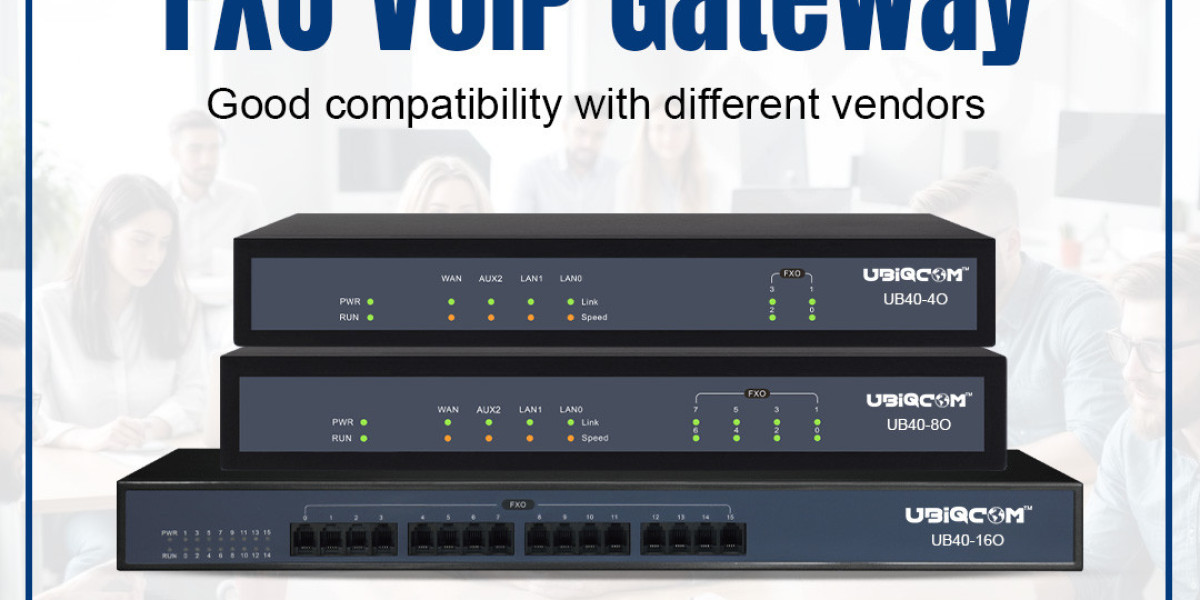

As businesses upgrade from legacy phone systems to modern VoIP communication, compatibility often becomes a challenge. Many offices still rely on analog telephone lines, PBX systems, or PSTN connections. This is where an FXO Gateway plays a crucial role. Designed to integrate analog phone lines with IP-based communication platforms, it ensures smooth, reliable, and cost-effective connectivity without replacing existing infrastructure.
What Is an FXO Gateway?
An FXO Gateway (Foreign Exchange Office Gateway) is a device that connects analog telephone lines—such as PSTN lines—to VoIP networks. It serves as a bridge, converting analog voice signals into digital packets and sending them across IP networks. This allows businesses to use traditional phone lines with modern IP PBX systems or cloud-based telephony solutions.
Equipped with multiple FXO ports, the gateway enables organizations to manage several analog lines simultaneously. From small offices to large enterprises, FXO gateways support flexible communication setups without disrupting existing workflows.
How an FXO Gateway Works
The FXO Gateway sits between the analog telephone line and the VoIP network. When a user makes or receives a call, the gateway converts the analog PSTN signal into digital VoIP data using standard SIP protocols. This conversion allows VoIP phones, softphones, and IP PBX systems to communicate with analog telephone lines.
Some gateways also support advanced features like call routing, failover switching, and remote management. These capabilities ensure stable communication, even during network interruptions or power fluctuations. By intelligently routing calls between PSTN and IP networks, the gateway provides continuity and reliability.
Key Features of FXO Gateway
1. PSTN to VoIP Integration
Enables seamless communication between traditional telephone lines and IP-based telephony systems.
2. Multi-Port Design
FXO gateways often come in 4, 8, or more port variants, allowing simultaneous handling of multiple lines for growing offices.
3. High Voice Quality
Advanced voice codecs ensure clear, distortion-free audio for business calls.
4. Intelligent Call Routing
Supports least-cost routing, failover features, and automatic switching between PSTN and VoIP networks.
5. Easy Deployment and Management
With web-based configuration and SIP protocol support, installation is quick and user-friendly.
Why Businesses Choose FXO Gateways
Companies prefer FXO gateways because they allow the use of existing analog lines while adopting VoIP. This hybrid approach eliminates the cost of replacing phone systems and helps enterprises transition at their own pace. The gateway provides:
Business continuity during internet outages
Flexibility to combine analog and VoIP services
A reliable backup path for mission-critical communication
Compatibility with major IP PBX and VoIP platforms
With FXO Gateway, organizations get a smooth, scalable, and efficient communication system that fits both traditional and modern environments.
Applications of FXO Gateway
• Small and Medium Businesses
Ideal for offices that still use PSTN lines but want VoIP features.
• Enterprises
Used to connect branch offices, remote sites, and existing telephone infrastructure.
• Hospitality Industry
Hotels rely on FXO gateways to integrate analog lines for guestrooms with IP PBX systems.
• Call Centers
Ensures uninterrupted inbound and outbound call operations, even during network issues.
• Emergency Backup Connectivity
Provides a fallback to PSTN lines when VoIP fails or the internet is down.
FXO vs FXS: Understanding the Difference
| Feature | FXO | FXS |
|---|---|---|
| Connects To | PSTN Line | Analog Telephone/Device |
| Purpose | Receives analog line | Sends dial tone |
| Use Case | Bridge PSTN with VoIP | Connect analog phones to IP PBX |
Both work together but serve different roles in telephony networks. FXO gateways specifically handle incoming lines from telecom providers.
Conclusion
The FXO Gateway remains an essential device for businesses transitioning from analog communication to modern VoIP systems. Its ability to integrate PSTN lines with IP networks ensures compatibility, reliability, and flexibility. Whether used for backup connectivity, hybrid communication, or seamless telephony integration, FXO gateways deliver stability and smooth performance. As organizations modernize their communication infrastructure, FXO gateways offer an effective bridge between legacy systems and next-generation VoIP technology.