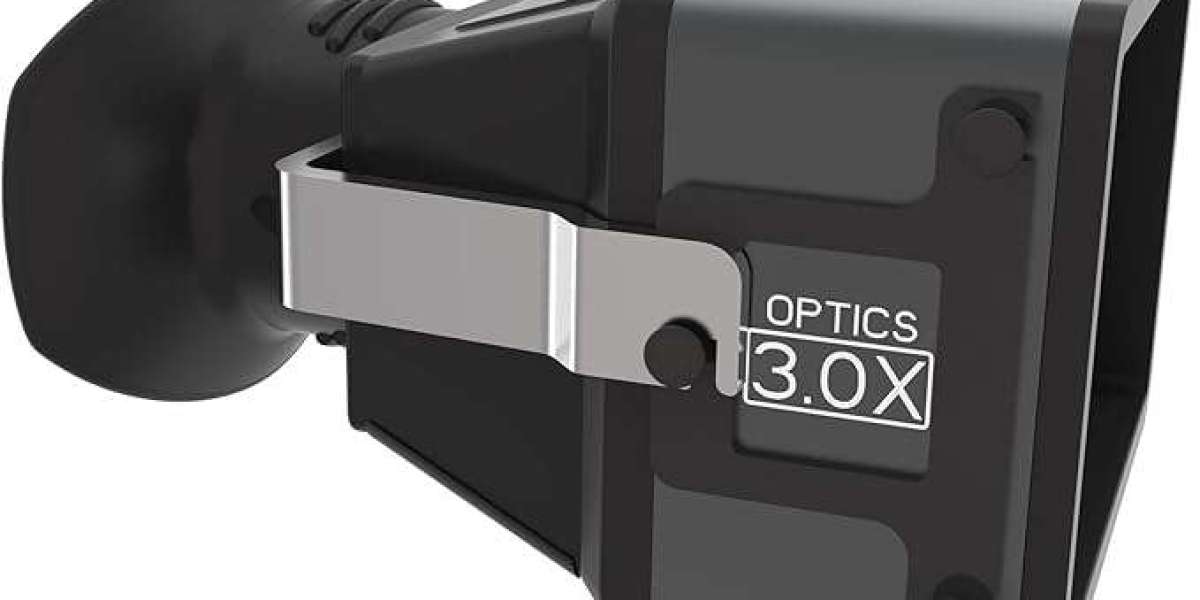

Designing a professional camera or medical scope often hits a wall when the EVF optical module fails to match the sensor's quality. If your eyepiece has soft edges, the user cannot accurately judge focus or color during a shoot.
In the B2B sector, reliability and user comfort are the primary drivers of hardware success. A viewfinder that causes eye strain or "tunnel vision" after just an hour of operation will lead to negative reviews and high product return rates.
We understand that balancing magnification with a comfortable eye box is a difficult engineering task. You need a solution where the display and the lens stack work together to provide a sharp, natural view that mimics the human eye.
The Challenge of Edge-to-Edge Sharpness and Diopter Shift
The most common struggle with an EVF optical module is peripheral blurring. When a high-resolution Micro OLED is placed behind a standard lens, the center may look crisp, but the corners often suffer from "smearing." For a professional cinematographer or a drone pilot, being unable to see the data overlays at the edges of the screen is a critical failure.
To solve this, professional-grade modules utilize a multi-element aspheric lens design. By using specialized glass with a high refractive index, we can flatten the image field. This ensures that the focus remains uniform across the entire display. Furthermore, a robust diopter adjustment mechanism is essential. It must move the optical group smoothly without introducing "tilt," which would otherwise cause one side of the image to go out of focus.
Eliminating the "Blackout" and Motion Blur Issues
In B2B applications like high-speed industrial monitoring, "latency" in the viewfinder can be dangerous. While much of this depends on the display driver, the optical module plays a role in how the eye perceives motion. If the exit pupil is too small, even a slight movement of the user's head causes a "blackout" effect where the image disappears.
Solving this requires a large exit pupil and a generous eye relief. By expanding the "eye box," the engineer allows the user to maintain a clear view even if their eye isn't perfectly centered. This is especially vital for helmet-mounted displays or handheld thermal imagers where the user is often moving in a high-stress environment.
Managing Internal Reflections and Flare in High-Brightness EVFs
When using a high-nits display to combat outdoor glare, internal reflections become a "ghostly" problem. Light from the Microdisplay can bounce off the internal walls of the lens barrel, creating a haze that washes out the Contrast Ratio. In medical imaging, where seeing subtle shade differences is vital for a diagnosis, this flare is unacceptable.
Professional manufacturers solve this by:
Anti-Reflective (AR) Coatings: Using broad-band coatings that handle multiple light angles.
Internal Baffling: Adding microscopic "ribs" inside the housing to trap stray light.
Light-Absorbing Materials: Using specialized matte-black resins for the lens spacers.
Thermal Stability in Compact Electronic Viewfinders
Electronic viewfinders generate a surprising amount of heat in a very small volume. Because the EVF optical module is often sealed to prevent dust ingress, this heat can build up and cause the plastic lenses to expand. This thermal expansion leads to "focus drift," where the image becomes blurry as the device warms up during use.
B2B-grade modules solve this through athermalized design. By matching the expansion rate of the lens cells with the optical glass, the focus remains locked regardless of the operating temperature. Using an aluminum or magnesium alloy housing instead of cheap plastic also helps pull heat away from the display backplane, ensuring the longevity of the organic light-emitting layers.
Conclusion
At Arvroptical, we manufacture and supply precision EVF optical modules for the world's leading B2B imaging brands. Our expert solutions ensure your viewfinder offers a clear, comfortable, and professional experience.