
An AI product description generator is a software tool that creates written product descriptions automatically using artificial intelligence. It takes basic product inputs such as features, category, audience, and tone, then turns them into readable descriptions that can be used on e-commerce websites, marketplaces, catalogs, or ads.
In simple terms, it reduces the time and effort needed to write product copy while keeping the content consistent across hundreds or thousands of items.
This is not magic writing. It is a system trained on large volumes of existing product content that learns patterns in how products are described and applies those patterns to new inputs.
Why have businesses started using AI product description generators
Writing product descriptions sounds easy until scale becomes a problem.
In real business settings, this usually happens when:
An e-commerce store adds hundreds of new SKUs in a short time
A marketplace seller lists the same product across multiple platforms
A D2C brand needs variations of copy for ads, listings, and catalogs
A team spends too much time rewriting similar descriptions again and again
Manual writing slows down launches. It also leads to uneven quality because different people write differently.
An AI product description generator helps solve these problems by handling first draft creation so teams can focus on review, compliance, and brand voice instead of starting from scratch every time.
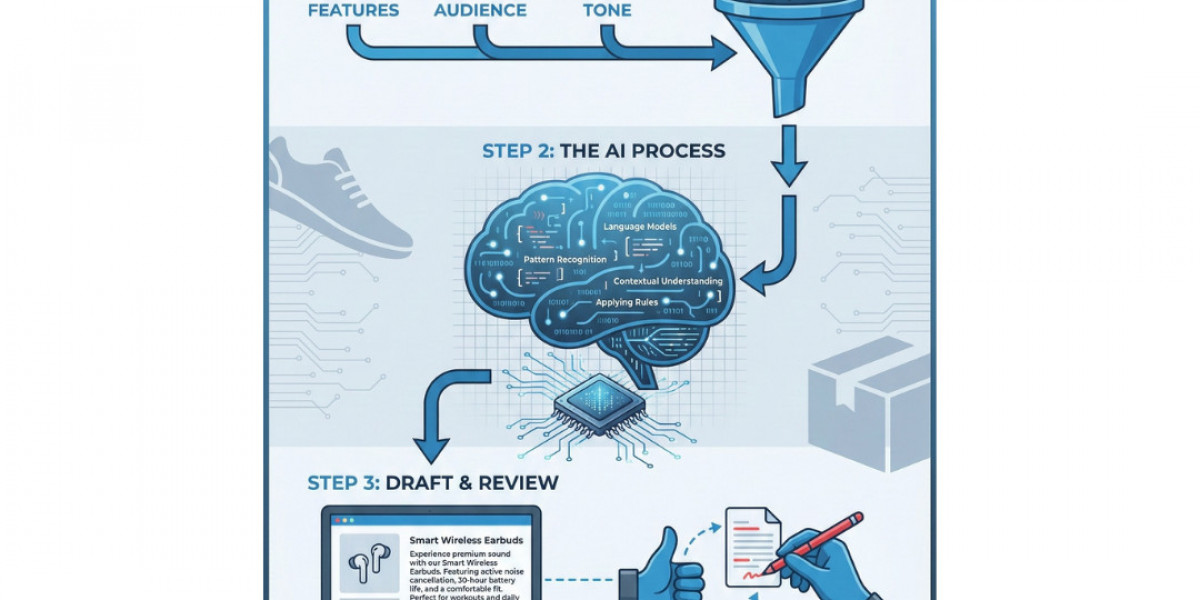
How an AI product description generator works
At its core, the system follows a structured process rather than creative thinking.
Step 1: The input data is provided
The user gives basic information such as:
Product name and category
Key features and specifications
Target customer or use case
Tone such as formal, casual, or technical
Platform requirements like Amazon, Shopify, or catalog copy
The quality of the output depends heavily on how clear this input is.
Step 2: Language patterns are applied
The AI uses trained language models to understand:
How similar products are usually described
Which details are commonly grouped together
What order is the informationpresented in
How language changes based on the audience or platform
It does not invent facts. It rearranges and rewrites based on known patterns.
Step 3: Draft content is generated
The tool produces a readable description that usually includes:
A short opening summary
Key benefits written in simple language
Feature explanations tied to usage
A closing line suitable for listings or pages
This output is meant to be reviewed, edited, and approved. It is not meant to be published blindly.
What AI does well in product description writing
From real usage across e-commerce and catalog-driven businesses, AI performs best at:
Handling repetitive product categories
Maintaining consistent tone across listings
Writing neutral and clear descriptions
Adapting length based on platform limits
Creating multiple variations quickly
For example, if a seller uploads 200 similar phone accessories, an ai product description generator can create usable drafts in minutes instead of days.
Where AI still needs human involvement
AI is a support tool, not a replacement for business judgment.
Human review is still needed for:
Brand-specific language and positioning
Legal and compliance checks
Cultural or regional wording accuracy
Claims related to performance or safety
Emotional or premium storytelling when required
Businesses that skip this step often end up with content that sounds generic or slightly off-brand.
Common business use cases
E-commerce stores
Online stores use AI to speed up product uploads, especially during seasonal launches or inventory expansion.
Marketplaces
Sellers listing on Amazon, Flipkart, or Etsy use AI to adjust descriptions for different rules and formats without rewriting everything manually.
Manufacturing and wholesale catalogs
Large catalogs with technical specs benefit from structured drafts that sales teams can quickly review and finalize.
Digital agencies and freelancers
Content teams use AI to create first drafts, then refine them based on client tone and goals.
Misunderstandings about AI product description generators
Many people assume these tools write perfect content on their own. That is not how they work in real businesses.
Common misunderstandings include:
AI understands the product deeply
AI replaces content writers completely
AI writes original brand stories
AI always follows platform rules perfectly
In reality, it is closer to a fast assistant than a decision maker.
How to get better results from an AI product description generator
Businesses that get good results usually follow simple practices:
Provide clear and structured product inputs
Avoid vague feature lists
Review and edit before publishing
Set tone guidelines once and reuse them
Combine AI output with human checks
When used this way, the tool saves time without hurting content quality.
Conclusion
An AI product description generator is a practical tool designed to handle repetitive writing tasks at scale. It works by learning how product descriptions are usually written and applying those patterns to new product data.
It helps businesses move faster, stay consistent, and reduce manual workload. However, it still depends on human input, review, and judgment to produce content that truly fits a brand and market.
Used correctly, it supports real business workflows rather than replacing them.
FAQs
Is an AI product description generator suitable for small businesses
Yes. Small businesses benefit the most when time and resources are limited.
Can an AI-written product description rank well on e-commerce platforms
They can, as long as the content is accurate, clear, and reviewed before publishing.
Does AI copy sound generic
It can if the inputs are weak. Clear instructions usually lead to better results.
Should AI content be edited before publishing
Yes. Editing helps maintain brand voice and avoid errors.
Can one tool handle different platforms?
Most tools can adapt length and style, but platform rules should still be checked manually.