
Flooring Estimating Services: Complete Guide to Accurate Finish Work Takeoffs
Finish work represents the final impression of any construction project, making accurate cost estimation critical for both profitability and client satisfaction. Whether you need flooring estimating services for a multi-story commercial building or painting estimating services for a residential development, precision in these highly visible trades directly impacts your competitive position and bottom line.
At Design to Estimate, we specialize in delivering comprehensive estimating services for finish trades that help contractors, subcontractors, and developers bid confidently on projects of all sizes. Our expertise in flooring and painting systems ensures your estimates capture every material, preparation requirement, and labor component necessary for complete and competitive pricing.
The Complexity of Flooring Estimating Services
Flooring installations involve far more complexity than simple square footage calculations might suggest. Professional flooring estimating services must account for material types, substrate preparation, installation methods, transition details, and waste factors that vary dramatically based on flooring type, room configuration, and project specifications.
Modern construction projects incorporate diverse flooring materials, each with unique estimating considerations. Carpet installations require pad underlayment, seaming allowances, and pattern matching for commercial-grade products. Luxury vinyl tile (LVT) and vinyl plank flooring need substrate leveling, adhesive selection based on traffic levels, and careful layout planning to minimize waste. Hardwood flooring involves species selection, grade specifications, finish options, and acclimation time that impacts project scheduling.
Tile and stone installations present additional complexity with grout joint sizing, pattern layouts, waterproofing membranes for wet areas, and specialized setting materials for different substrate types. A simple bathroom floor might require crack isolation membrane, thinset mortar, tile, grout, and sealers—each calculated separately based on coverage rates and waste factors.
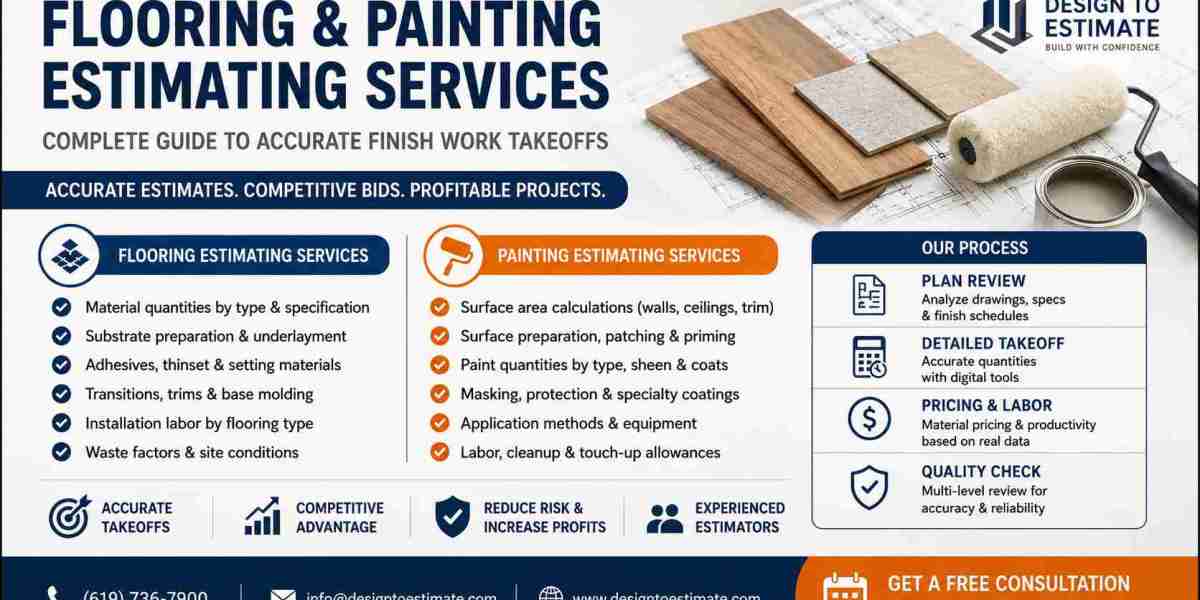
Critical components in flooring estimating services include:
- Flooring material quantities by type and specification
- Substrate preparation including leveling compounds and moisture barriers
- Underlayment materials for carpet, laminate, and engineered wood
- Adhesives, thinset, and setting materials with proper coverage rates
- Transition strips, reducers, and edge treatments
- Base molding and quarter round trim
- Installation labor by flooring type and complexity
- Floor protection and site cleanup requirements
Design to Estimate's flooring estimating services provide detailed quantity takeoffs from architectural drawings, material specifications matching project requirements, and labor calculations based on actual installer productivity rates for different flooring types and site conditions.
Understanding Painting Estimating Services
Painting represents one of construction's most labor-intensive finish trades, where accurate estimating separates profitable projects from financial losses. Painting estimating services must account for surface preparation, primer requirements, finish coat specifications, application methods, and the countless details that impact both material consumption and labor productivity.
Surface area calculations form the foundation of painting estimates, but experienced estimators know that wall and ceiling areas represent just the starting point. Substrate conditions dramatically impact costs—new drywall requires different preparation than repaints, and damaged surfaces need repair before painting. Texture matching, stain blocking, and specialty primers all add costs that must be captured during estimating.
Paint specifications vary widely in quality, coverage rates, and pricing. Builder-grade flat paint for apartment interiors costs significantly less than premium zero-VOC eggshell finishes for high-end residential projects. Commercial projects often specify specific manufacturers and product lines, requiring estimators to price exact products rather than generic equivalents.
Application methods impact both material usage and labor productivity. Spray application covers large areas quickly but requires extensive masking and protection. Brush and roller application takes longer but provides better control in occupied spaces or areas with extensive trim work. Estimators must select appropriate methods based on project conditions and specifications.
Essential elements in painting estimating services include:
- Surface area calculations for walls, ceilings, and trim
- Substrate preparation including patching, sanding, and priming
- Paint quantities by type, sheen, and number of coats
- Specialty coatings for moisture resistance or fire rating
- Masking materials and surface protection
- Equipment including sprayers, scaffolding, and lifts
- Installation labor by surface type and application method
- Touch-up allowances and final cleaning
Design to Estimate's painting estimating services deliver comprehensive takeoffs that account for every preparation step, material requirement, and labor component necessary for quality installations that meet project specifications and client expectations.
Integration of Flooring and Painting Systems
Flooring and painting work intersect at critical junctures where proper sequencing and coordination determine project efficiency and quality outcomes. Base molding installation, for example, can occur before or after flooring depending on flooring type and project preferences. These sequencing decisions impact both trades' productivity and must be considered during estimating.
Wall preparation and painting typically occur before flooring installation to avoid damage to finished floors, but final touch-up painting happens after flooring completion. Estimators must account for floor protection materials during painting operations and potential touch-up requirements after flooring installation when calculating complete project costs.
Transition details between flooring types require coordination between flooring installers and painters. Thresholds, reducers, and edge treatments must align with base molding and door casings, requiring careful measurement and installation sequencing. Professional estimating accounts for these coordination requirements, ensuring adequate time and materials for proper execution.
Estimating Process and Methodology
Professional estimating for finish trades follows systematic processes that ensure accuracy and completeness. Design to Estimate begins every estimate with thorough document review, examining architectural drawings, finish schedules, specifications, and details to understand all project requirements fully.
Flooring takeoffs measure room areas from floor plans, adjusting for closets, alcoves, and irregular shapes. We apply appropriate waste factors based on flooring type and room configuration—tile installations in small bathrooms with numerous cuts require higher waste factors than carpet in large open areas. Pattern matching for carpet or luxury vinyl tile adds additional waste that must be calculated accurately.
Painting takeoffs calculate wall and ceiling areas from floor plans and building sections, then subtract openings for doors and windows. We measure linear footage of base molding, door and window casings, and other trim elements separately since these require different labor rates than wall painting. Multiple coat requirements multiply material quantities and labor hours appropriately.
Digital takeoff tools improve both accuracy and efficiency compared to manual methods. We measure directly from PDF drawings with automatic area calculations and built-in error checking. This technology provides audit trails for verification and enables rapid responses to addenda or design changes during compressed bid schedules.
Material Selection and Pricing
Finish material selection dramatically impacts project costs, making accurate specification interpretation essential for competitive estimating. Design to Estimate maintains current pricing from major manufacturers and distributors, ensuring our estimates reflect actual available costs rather than outdated or theoretical pricing.
Flooring materials range from economical vinyl composition tile at $2 to $4 per square foot to exotic hardwoods exceeding $15 per square foot. Understanding specification requirements and providing appropriate products prevents both overpricing that loses bids and underpricing that erodes profitability.
Paint pricing varies based on quality, brand, and performance characteristics. Premium paints cost more per gallon but often provide better coverage and durability, potentially reducing overall project costs through fewer coats and longer service life. Our estimates consider total installed cost rather than simply selecting the lowest material price.
Labor Productivity Factors
Labor represents the largest cost component in both flooring and painting installations, making accurate productivity assessment critical for competitive estimating. Design to Estimate's labor calculations draw on industry standards, historical project data, and adjustment factors for project-specific conditions.
Flooring installation productivity varies significantly based on material type, substrate conditions, and room configuration. Installers lay sheet vinyl or carpet tile in large open areas much faster than cutting and fitting hardwood in rooms with numerous closets and angles. Our estimates account for these variations, ensuring labor costs reflect actual installation conditions.
Painting productivity depends on surface conditions, application methods, and access requirements. Painters cover new drywall with spray equipment faster than repainting textured walls with rollers. High ceilings requiring scaffolding or lifts reduce productivity compared to standard eight-foot ceilings. We adjust baseline productivity for project-specific factors that impact crew efficiency.
Quality Control and Verification
Accurate estimating requires rigorous quality control processes that catch errors before bid submission. Design to Estimate employs multi-level review procedures ensuring every estimate undergoes verification by experienced estimators beyond the original takeoff preparer.
Our quality control process includes mathematical verification of all calculations, cross-checking quantities against multiple drawing sources, specification compliance review, and reasonableness checks comparing unit costs and productivity rates against historical benchmarks. This systematic approach minimizes errors that could compromise your competitive position or profitability.
Frequently Asked Questions
How do you handle flooring waste factors in estimates?
Waste factors vary by flooring type and installation pattern. We typically apply 5-10% for carpet and vinyl, 10-15% for tile depending on layout complexity, and 7-12% for hardwood based on room configuration and board lengths.
What information is needed for accurate painting estimates?
We require floor plans, finish schedules specifying paint types and sheens, wall heights from building sections, and specifications detailing surface preparation and coating requirements. Photos of existing conditions help for repaint projects.
Do you estimate specialty flooring like epoxy or polished concrete?
Yes, our team has experience estimating specialty flooring systems including epoxy coatings, polished concrete, terrazzo, and raised access floors for commercial and industrial applications.
Can you provide estimates for occupied building renovations?
Absolutely. We account for additional protection requirements, limited work hours, phasing considerations, and reduced productivity factors typical of occupied renovation projects.
Your Finish Work Estimating Partner
Accurate flooring estimating services and painting estimating services require both technical knowledge and practical installation experience. Design to Estimate combines detailed understanding of finish systems with proven estimating methodologies, delivering estimates you can trust for competitive bidding and project planning.
Our team has estimated thousands of projects across residential, commercial, institutional, and industrial sectors, giving us the breadth of experience to handle any building type or complexity level. We understand regional variations in materials, methods, and pricing, ensuring your estimates reflect local market conditions.
Ready to improve your estimating accuracy? Contact Design to Estimate today for a complimentary consultation. We'll discuss your project requirements, explain our detailed estimating process, and show you how our services can help you win more profitable work. Let's build your competitive advantage together.