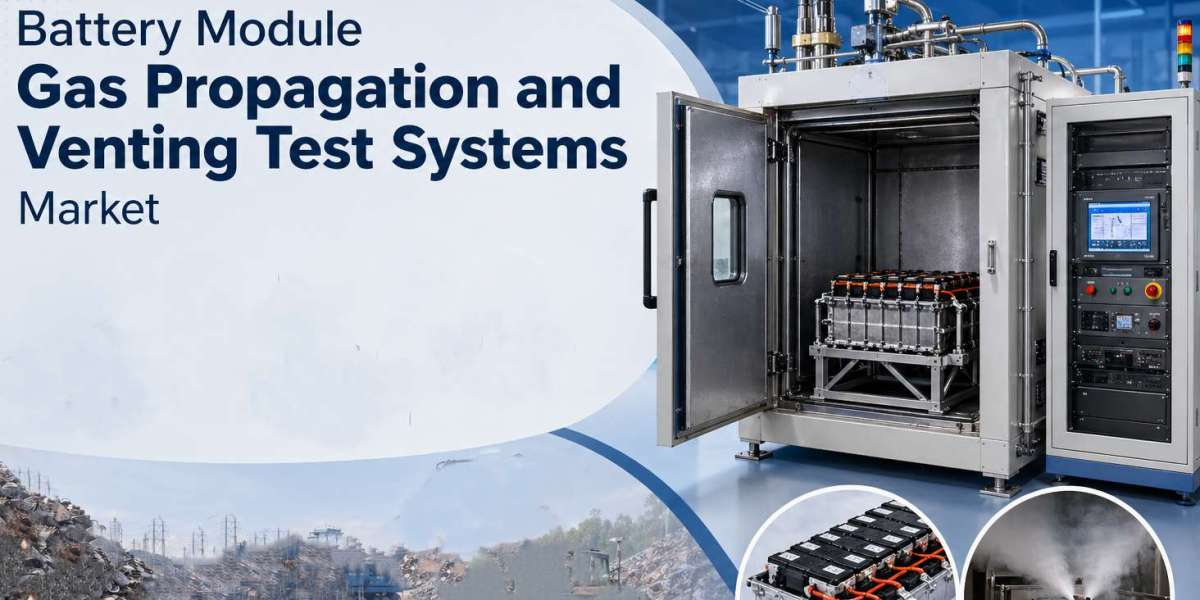

The global Battery Module Gas Propagation and Venting Test Systems Market is entering a high-growth phase, driven by escalating safety validation requirements across electric vehicle (EV) and stationary energy storage ecosystems. Valued at USD 167.6 million in 2025, the market is projected to reach USD 184.7 million in 2026 and surge to USD 487.9 million by 2036, expanding at a steady 10.2% CAGR over the forecast period.
As battery energy density increases, manufacturers and testing laboratories are under mounting pressure to validate how thermal runaway events propagate within modules—especially how gases are released, contained, or ignited under extreme conditions.
Market Growth Drivers
The market’s expansion is strongly anchored in evolving global battery safety expectations and regulatory frameworks.
Key growth drivers include:
- Increasing adoption of electric vehicles and large-scale battery energy storage systems (BESS)
- Stricter compliance with safety frameworks such as UL 9540A and UNECE R100
- Rising need for repeatable gas release, pressure, and thermal propagation data
- Shift from basic abuse testing to integrated, high-fidelity validation systems
Battery developers are increasingly prioritizing test systems that can simulate real-world failure scenarios and provide defensible engineering data for certification and design optimization.
Get detailed market forecasts, competitive benchmarking, and pricing trends: https://www.futuremarketinsights.com/reports/sample/rep-gb-32885
Emerging Trends Reshaping the Market
The industry is witnessing a structural shift from standalone test setups to fully integrated validation ecosystems.
Key trends include:
- Growing dominance of propagation chambers, expected to hold 34% market share in 2026
- Expansion of module-level testing, accounting for 44% of total demand
- Increased integration of gas analysis, pressure sensors, and thermal monitoring systems
- Adoption of deflagration and venting rigs for high-risk safety simulations
- Strong preference for turnkey systems with advanced safety architecture and automation
These advancements are enabling labs to capture high-resolution data on vent gas behavior, flame propagation, and enclosure response—critical inputs for next-generation battery design.
Regional Insights
Geographically, the market is witnessing strong diversification of demand.
- China leads global growth with a projected 11.4% CAGR, driven by large-scale EV production and battery validation activity
- India follows closely at 11.0% CAGR, supported by expanding domestic manufacturing and energy storage initiatives
- The United States (10.6%) remains a key hub for EV and grid storage testing programs
- Germany and the United Kingdom continue to invest in advanced certification-driven battery safety infrastructure
- Japan and South Korea are strengthening export-oriented battery engineering and testing ecosystems
China and India are emerging as the fastest-expanding markets, while North America and Europe remain critical centers for regulatory compliance and advanced testing innovation.
Competitive Landscape
The competitive environment is moderately consolidated, with leading global players focusing on system integration, safety engineering, and advanced measurement capabilities.
Key companies operating in the market include:
Weiss Technik, ESPEC, AVL, Binder, UL Solutions, Intertek, Thermotron, Angelantoni Test Technologies, CSZ
These companies are competing on parameters such as:
- Chamber containment strength and safety design
- Depth of gas and thermal analytics
- Integration of automated control systems
- Compliance with global battery safety standards
- Engineering support and turnkey installation capabilities
UL Solutions and ESPEC, in particular, are expanding their global testing infrastructure to support growing EV and stationary storage validation demand.
Analyst Insights and Strategic Outlook
According to sector analysis, suppliers that can deliver repeatable gas propagation evidence, enhanced safety architecture, and faster deployment into validation workflows are expected to gain a competitive edge.
The increasing complexity of battery systems—especially in EV platforms—means developers are no longer relying on simple pass/fail testing. Instead, they require multi-layered insights into gas dynamics, pressure evolution, and thermal spread behavior.
Future Opportunities
The market’s future growth is closely tied to:
- Expansion of EV production platforms globally
- Rising deployment of grid-scale energy storage systems
- Increasing regulatory scrutiny of battery fire safety
- Adoption of high-density lithium-ion and next-generation chemistries
As battery technologies evolve, demand for advanced propagation and venting test systems will continue to strengthen, positioning the market as a critical pillar in global energy transition infrastructure.
Request Sample Report with Complete Market Breakdowns and Growth Estimates: https://www.futuremarketinsights.com/reports/battery-module-gas-propagation-and-venting-test-systems-market
Have a specific Requirements and Need Assistant on Report Pricing or Limited Budget please contact us – sales@futuremarketinsights.com
About Future Market Insights (FMI)
Future Market Insights, Inc. (FMI) is an ESOMAR-certified, ISO 9001:2015 market research and consulting organization, trusted by Fortune 500 clients and global enterprises. With operations in the U.S., UK, India, and Dubai, FMI provides data-backed insights and strategic intelligence across 30+ industries and 1200 markets worldwide.
Why Choose FMI: https://www.futuremarketinsights.com/why-fmi